Hefex Etna / The first AI-native pick and place machine
Pick & place, built
for PCB prototyping
From loose components to an assembled PCB in under 10 minutes.
- No expertise needed
- 90% less setup time
- Any component feeding
Founding batch, limited
Supported by







'/%3e%3cpath%20d='M146.35,44.08h-6.89v.77h3v8.87h.86V44.85h3ZM132.1,48.93c0,3.14.62,4.93,3.47,4.93a13.72,13.72,0,0,0,2.59-.29l0-.75a15.6,15.6,0,0,1-2.47.26c-2.31,0-2.67-1.43-2.67-4.15s.34-4.22,2.66-4.22a16.37,16.37,0,0,1,2.48.27l0-.75a13.47,13.47,0,0,0-2.59-.29c-2.91,0-3.47,1.83-3.47,5M134,37.54h-3.86l1.56-5.47h.74ZM135,41h.84l-2.74-9.64h-2L128.33,41h.86L130,38.3h4.26Zm-4.18,3.12h-5.74v9.64h5.74V53h-4.89V49.2H130v-.77h-4.07V44.85h4.89Zm-5-12.76v4.43h-5.2V31.32h-.85V41h.85V36.51h5.2V41h.84V31.32Zm-8.11,13.52h2.65c1.48,0,2.09.74,2.09,2.29s-.61,2.47-2.09,2.47h-2.65Zm2.65-.76h-3.5v9.64h.85V50.36h2.65c2,0,3-1.16,3-3.23s-.92-3.05-3-3.05M115.12,41V32.1h3v-.78h-6.89v.78h3V41Zm-7,3.12,3,4.89-3,4.75H109l2.6-4.16,2.56,4.16h1l-3-4.76,3-4.88h-.94l-2.57,4.26-2.59-4.26Zm-1.67-15.9V20.31H109V18.6h-7v1.71h2.56v7.87ZM101.14,41h5.75V40.2H102V36.44h4.06v-.76H102V32.1h4.89v-.78h-5.75Zm5.55,3.12H101v9.64h5.74V53H101.8V49.2h4.07v-.77H101.8V44.85h4.89ZM93.53,36.4V32.08h2.66c1.43,0,2.09.67,2.09,2.11s-.54,2.21-2.09,2.21Zm0,.76h2.92L98.33,41h1l-2-4a2.56,2.56,0,0,0,1.84-2.82c0-2-1-2.86-3-2.86H92.67V41h.86Zm-3.46,6.92h-.84v6.81c0,2.15,1.2,3,3.22,3s3.33-.82,3.33-3V44.08h-.85v6.81c0,1.61-.9,2.19-2.48,2.19s-2.38-.6-2.38-2.19ZM88.2,26.49v-2.3h3.41V22.53H88.2V20.29h4.25V18.6H86.26v9.58h6.19V26.49ZM86.85,32c2.33,0,2.87,1.53,2.87,4.23s-.48,4.14-2.87,4.14S84,38.92,84,36.19,84.51,32,86.85,32m0-.78c-2.94,0-3.73,1.83-3.73,5s.77,4.91,3.73,4.91,3.75-1.59,3.75-4.91-.8-5-3.75-5M80.6,49c0-2.72.51-4.24,2.85-4.24s2.87,1.53,2.87,4.24-.48,4.13-2.87,4.13S80.6,51.68,80.6,49m-.88,0c0,3.2.77,4.91,3.73,4.91S87.2,52.26,87.2,49s-.8-5-3.75-5-3.73,1.83-3.73,5m-6.84-4.87h-.95L75,49.64v4.08h.85V49.64l3.07-5.56H78l-2.53,4.67Zm.65-12.76h-1.6V41h.85V32.21H73l3,8.43h1l3-8.43h.2V41H81V31.32h-1.6l-2.94,8.44Zm4.6-12.72h-6.2v9.58h6.2V26.49H73.87v-2.3h3.41V22.53H73.87V20.29h4.26Zm4.53-3.35L84.5,5.67h-2l-1.18,7.92h-.21L79.34,5.67H77.09l-1.72,7.92h-.21L74,5.67h-2l1.83,9.58h2.95L78.21,8l1.51,7.28ZM79.51,28.18H85V26.46H81.45V18.6H79.51ZM85.86,7.63h2v-2h-2Zm5.36,0h1.94v-2H91.22ZM93.16,12V8.52H91.22v3.53a1.71,1.71,0,0,1-3.41,0V8.52h-2V12c0,2.4,1.26,3.41,3.65,3.41s3.65-1,3.65-3.41m2.7,6.59H93.92v9.58h1.94V24.5l1.3-.14,1.61,3.82H101L98.86,23.4,101,18.6H98.74l-1.58,4.07-1.3.14Zm4.3-9.75c0,.85-.4,1.53-1.37,1.53H97V7.33h1.77a1.34,1.34,0,0,1,1.4,1.52m2,0c0-2.19-1.19-3.16-3.38-3.16H95v9.58H97V12h1.87L100,15.25h2.13l-1.36-3.66a3,3,0,0,0,1.4-2.76m5.55-1.44h2.53V5.67h-7V7.39h2.56v7.86h2Zm4.55,12.87H114c.93,0,1.39.6,1.39,1.52S115,23.3,114,23.3h-1.8ZM114,18.6H110.3v9.58h1.94V25h1.87l1.12,3.22h2.13L116,24.51a3,3,0,0,0,1.41-2.76c0-2.18-1.2-3.15-3.38-3.15m3.1-3.35h1.94V5.67h-1.94V9.59h-3.57V5.67h-1.94v9.58h1.94v-4h3.57Zm7.54,8.19c0,2.22-.39,3.22-2,3.22s-2-1-2-3.22.39-3.32,2-3.32,2,1.11,2,3.32m2,0c0-3.24-1-5-4-5s-4,1.77-4,5,1,4.91,4,4.91,4-1.67,4-4.91m6.06,4.74h3.2V18.6H134v7.89h-.14l-2.32-7.89h-3.28v9.58h1.95V20.29h.14Zm6.49,3.14h-1.68V41h.85V32.1h.3l4,8.86h1.65V31.32h-.84V40.2h-.32ZM138,28.18h1.95V18.6H138Zm8.72-4.78,2.08-4.8h-2.21L145,22.67l-1.29.14V18.6h-2v9.58h2V24.5l1.29-.14,1.61,3.82h2.24Z'%20transform='translate(0%200)'/%3e%3c/svg%3e)

≤ 10 min
From file upload to assembled PCB
Any format
Reels, trays, tape or loose
No expertise
The AI does the setup work
How the Hefex Etna works
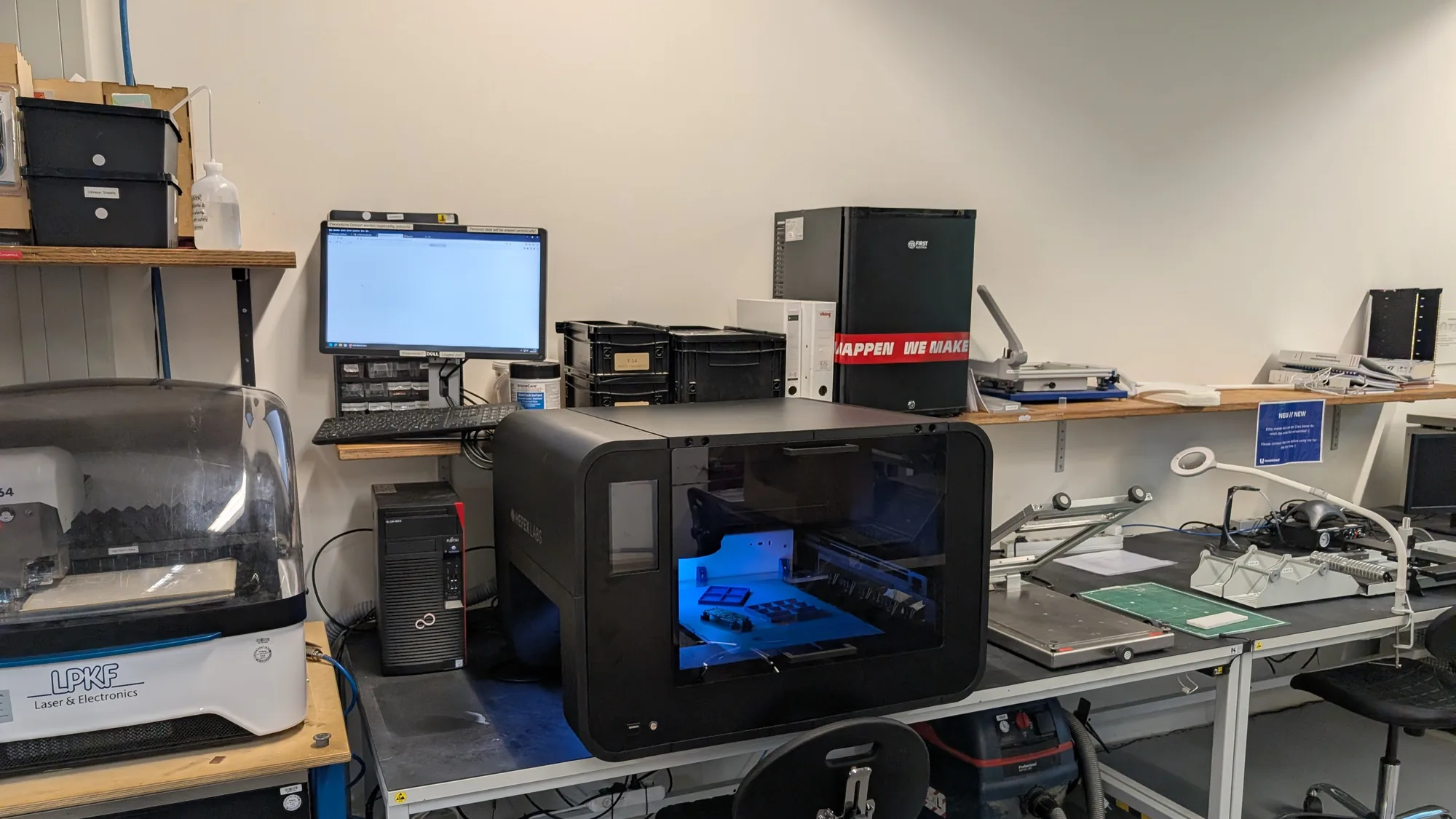
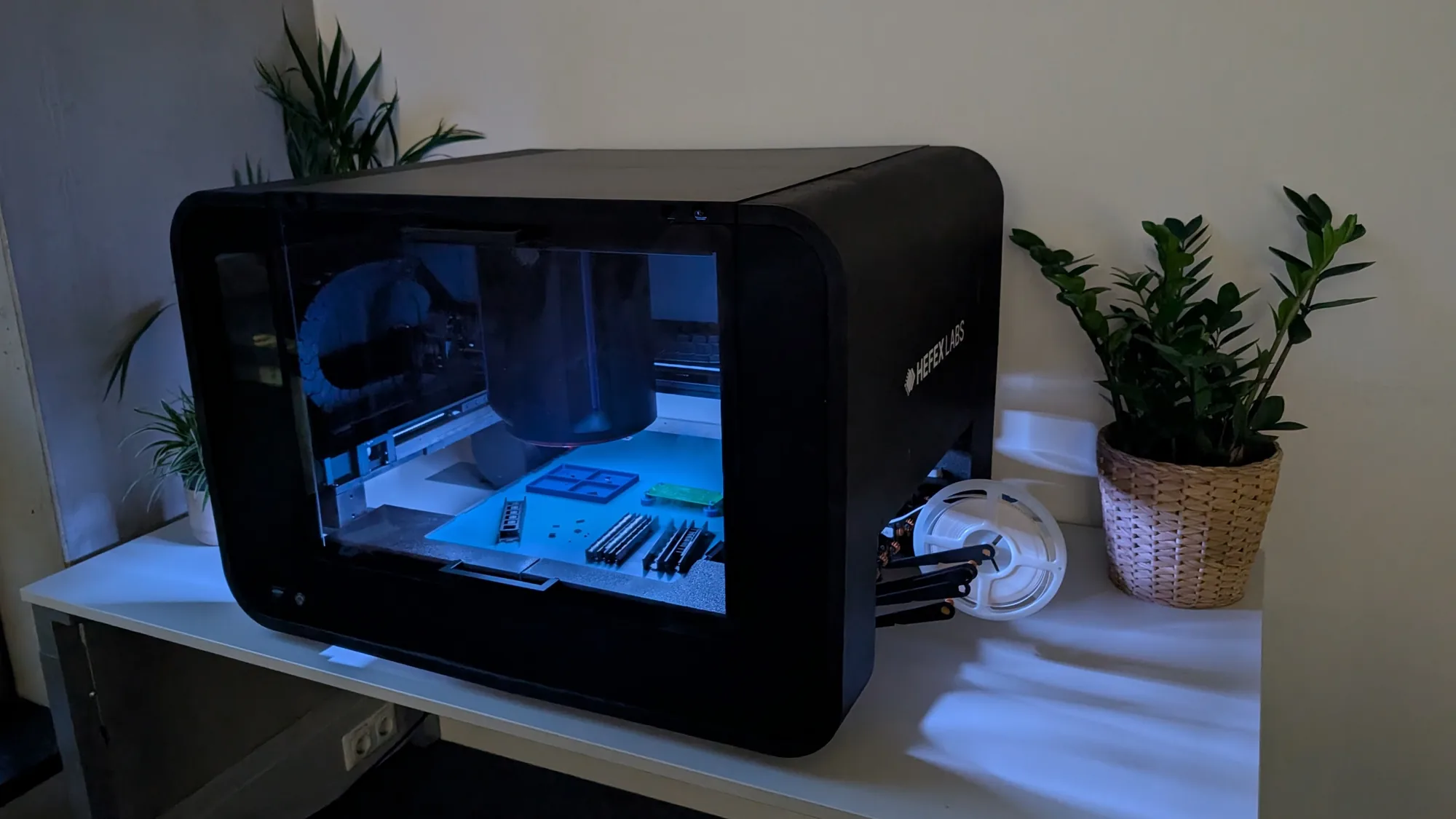
- Components loose, in trays, on cut tape or in feeders
- Board fixed or loose
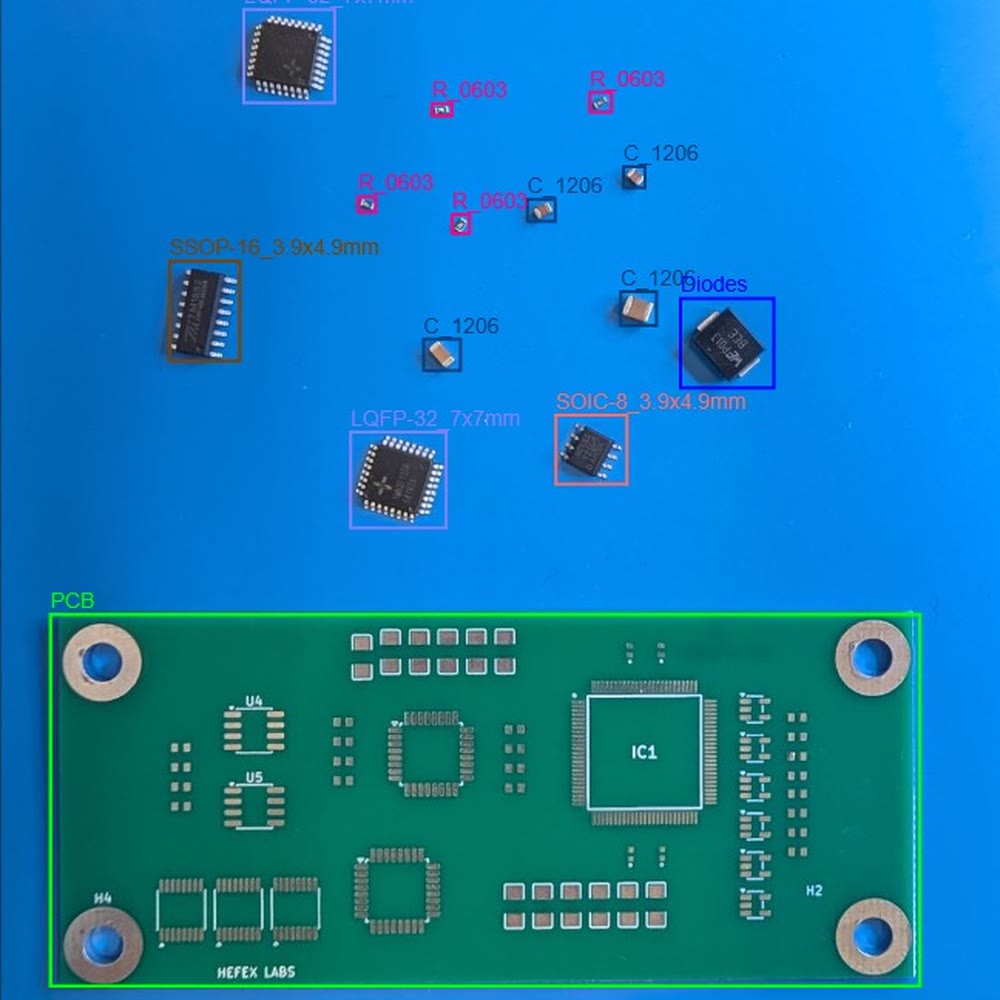
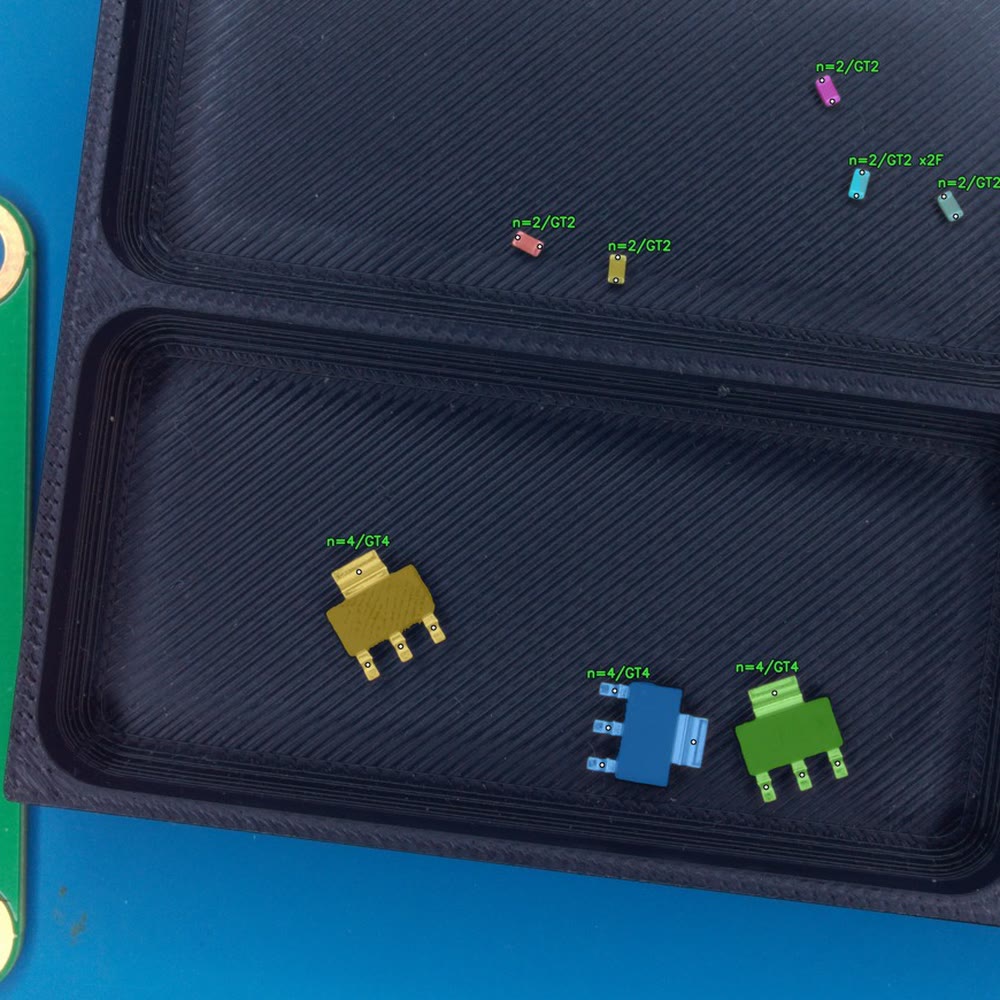
- The machine finds all of it, fully automatic
The machine takes over the work the operator used to do.
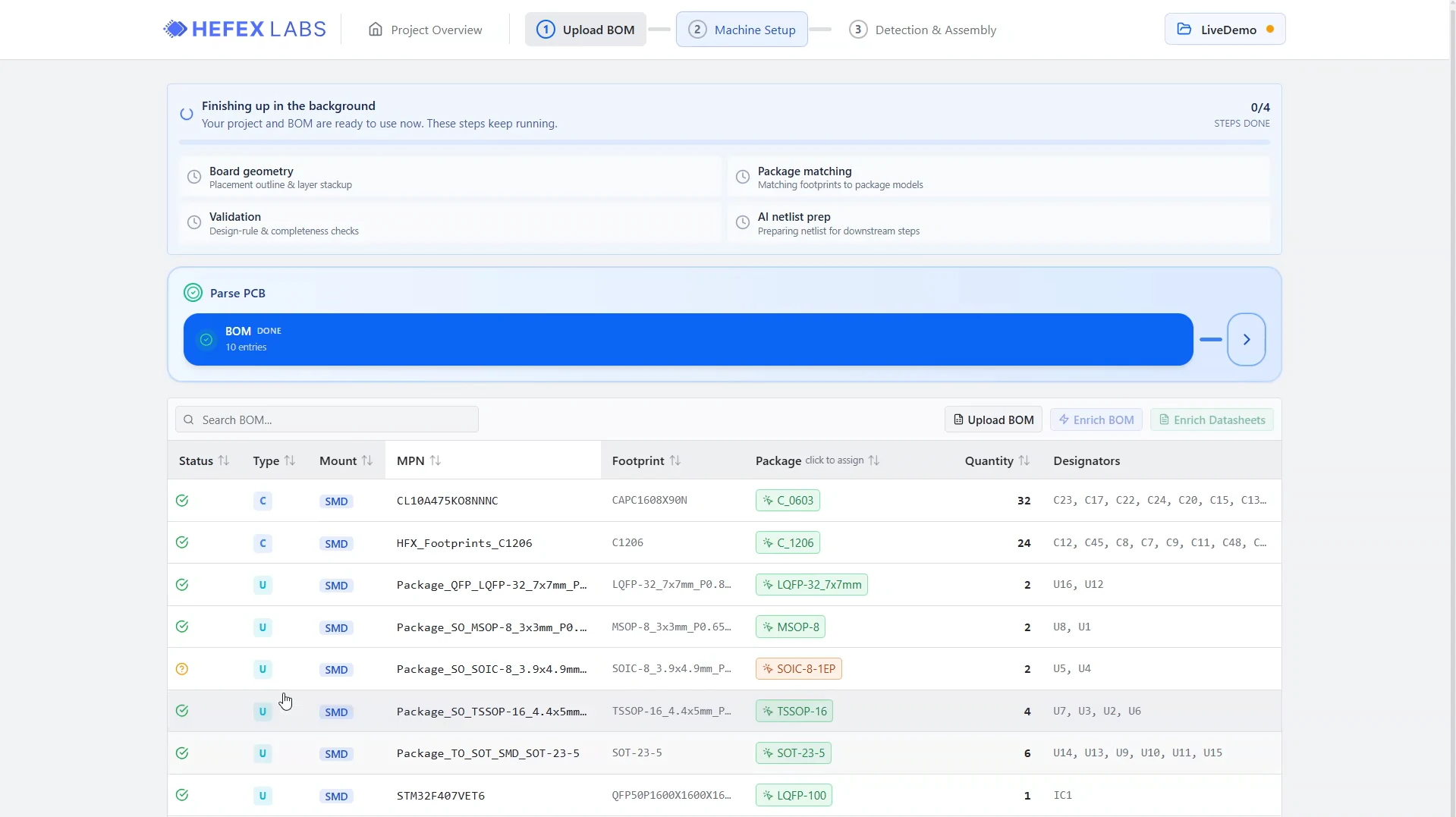
Upload the files exactly as your CAD tool exports them. The software automatically sorts out board origin, part rotations and unknown packages. No manual reformatting required.
Upload your design files
Upload the files exactly as your CAD tool exports them. The software automatically sorts out board origin, part rotations and unknown packages. No manual reformatting required.
Run detection
The machine scans the work area and finds every part, whether loose, on cut tape, in trays or in feeders, and the board wherever you put it. Nothing has to be sorted, taught or calibrated first.
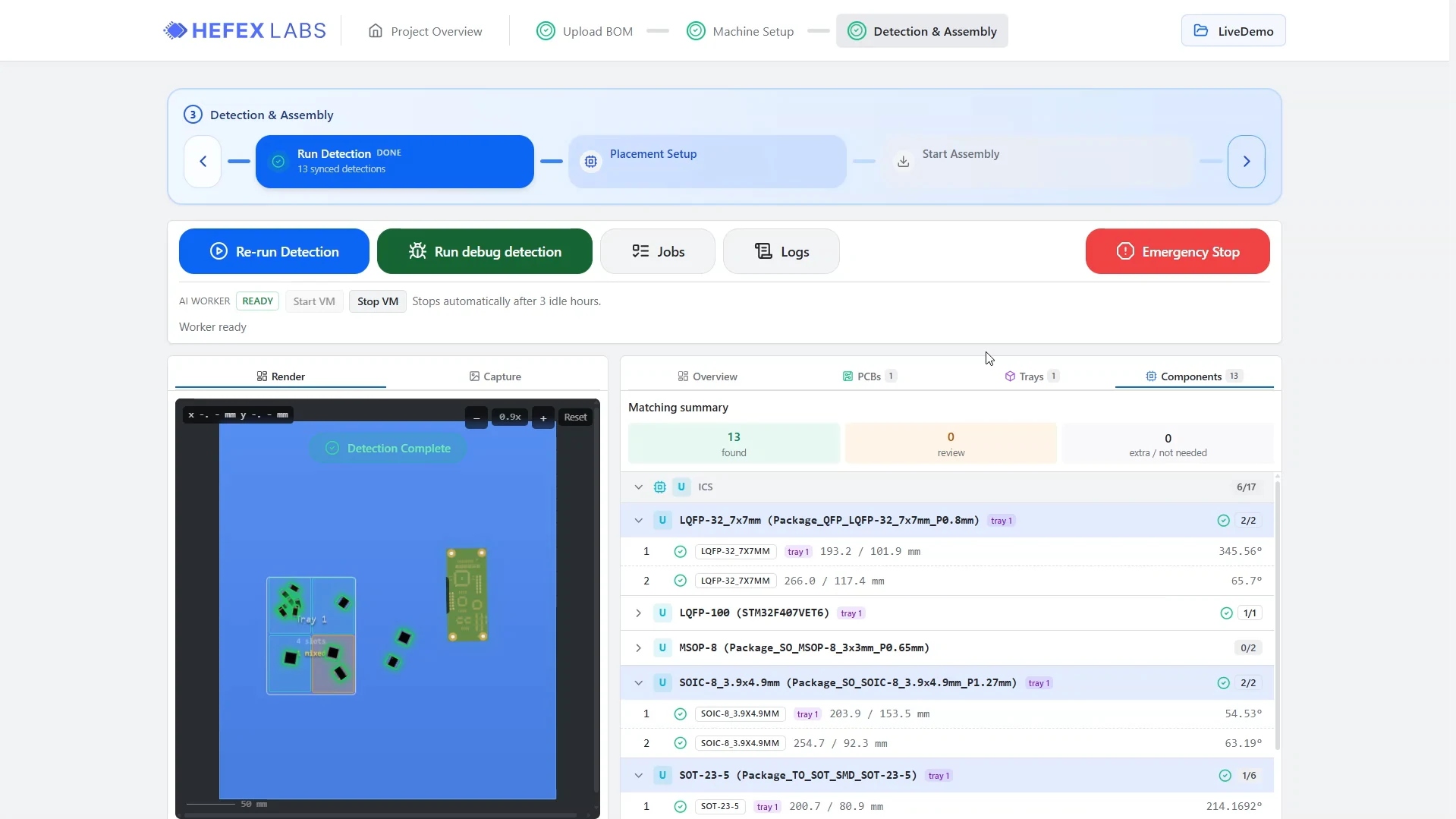
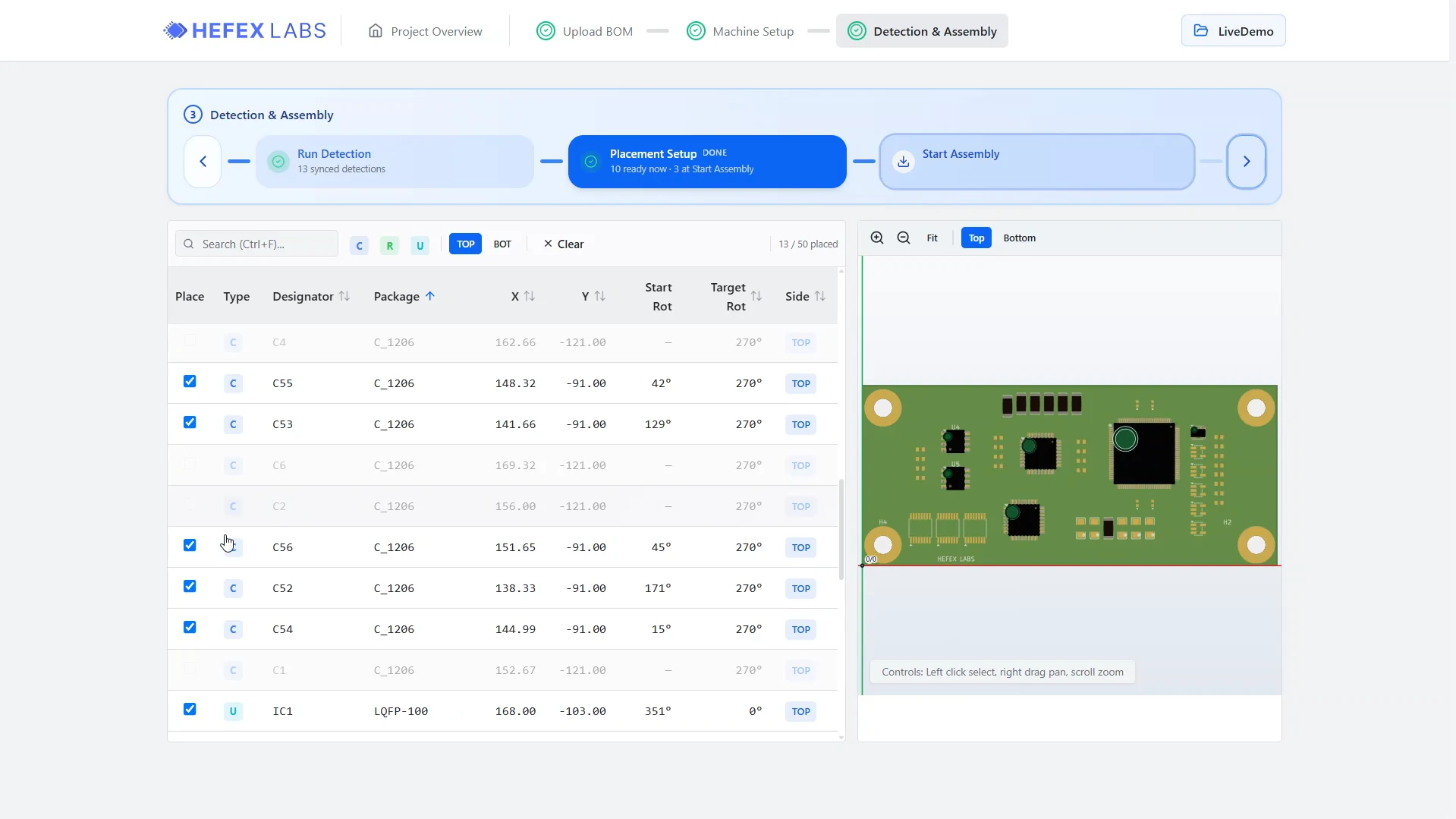
Placement setup
The vision AI identifies every component and matches it to your design data, so it knows what each part is and where it belongs.
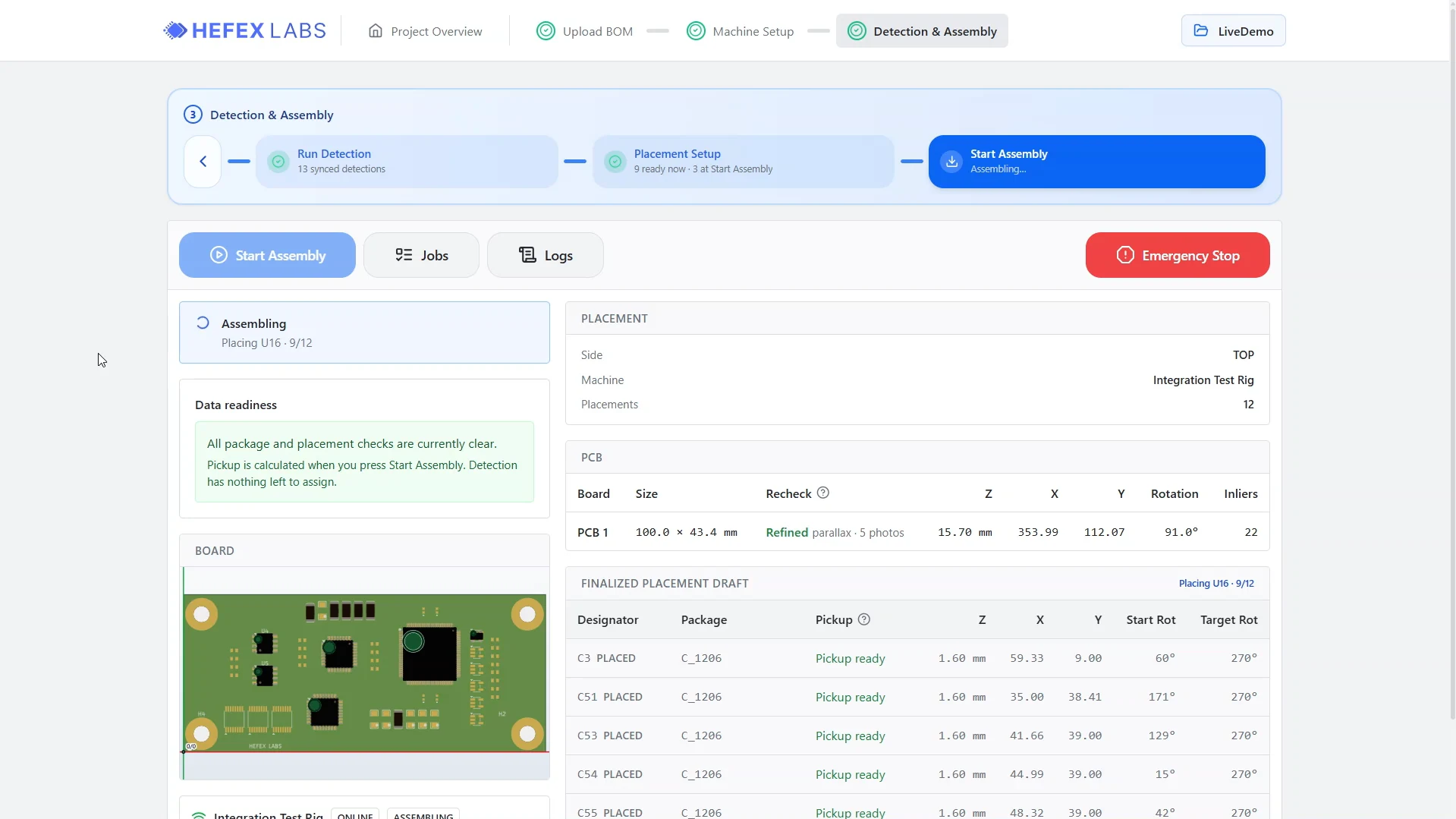
Placement
Start the job. The machine picks each part from where it lies and places it. The progress can be followed live in the web app.
A real run in real time, nothing sped up: loose components to an assembled PCB in under 10 minutes, setup included.
Playing loads the video from YouTube.
Why this wasn't possible until recently
Vision models have become far more capable
Reliably detecting loose components of any shape and size needs vision models that we train ourselves. The architectures and training methods behind them have only become good enough in the last few years.
Cloud inference only just got cheap
Fast, cheap GPU inference as a service is recent. A few years ago, the compute cost alone would have made a pipeline like ours uneconomical.
Software-first wasn't proven yet
Pick-and-place was long treated as a hardware problem. Existing vendors pushed their complexity into manual programming instead of solving it in software.
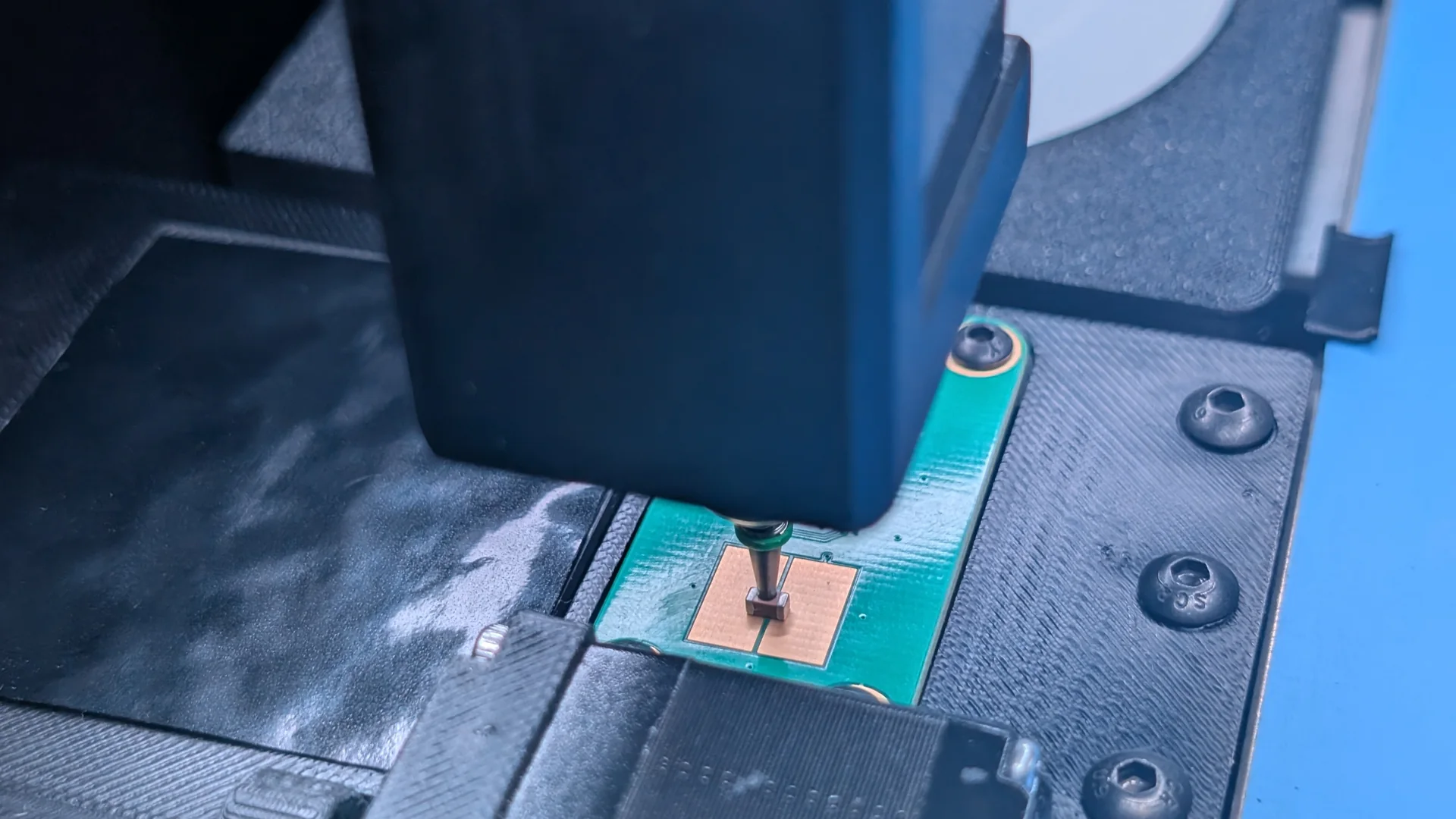
Built-in test pads let the machine measure a part electrically, so it can tell apart components that look the same, such as resistors with different values.
Impedance test pads
Built-in test pads let the machine measure a part electrically, so it can tell apart components that look the same, such as resistors with different values.
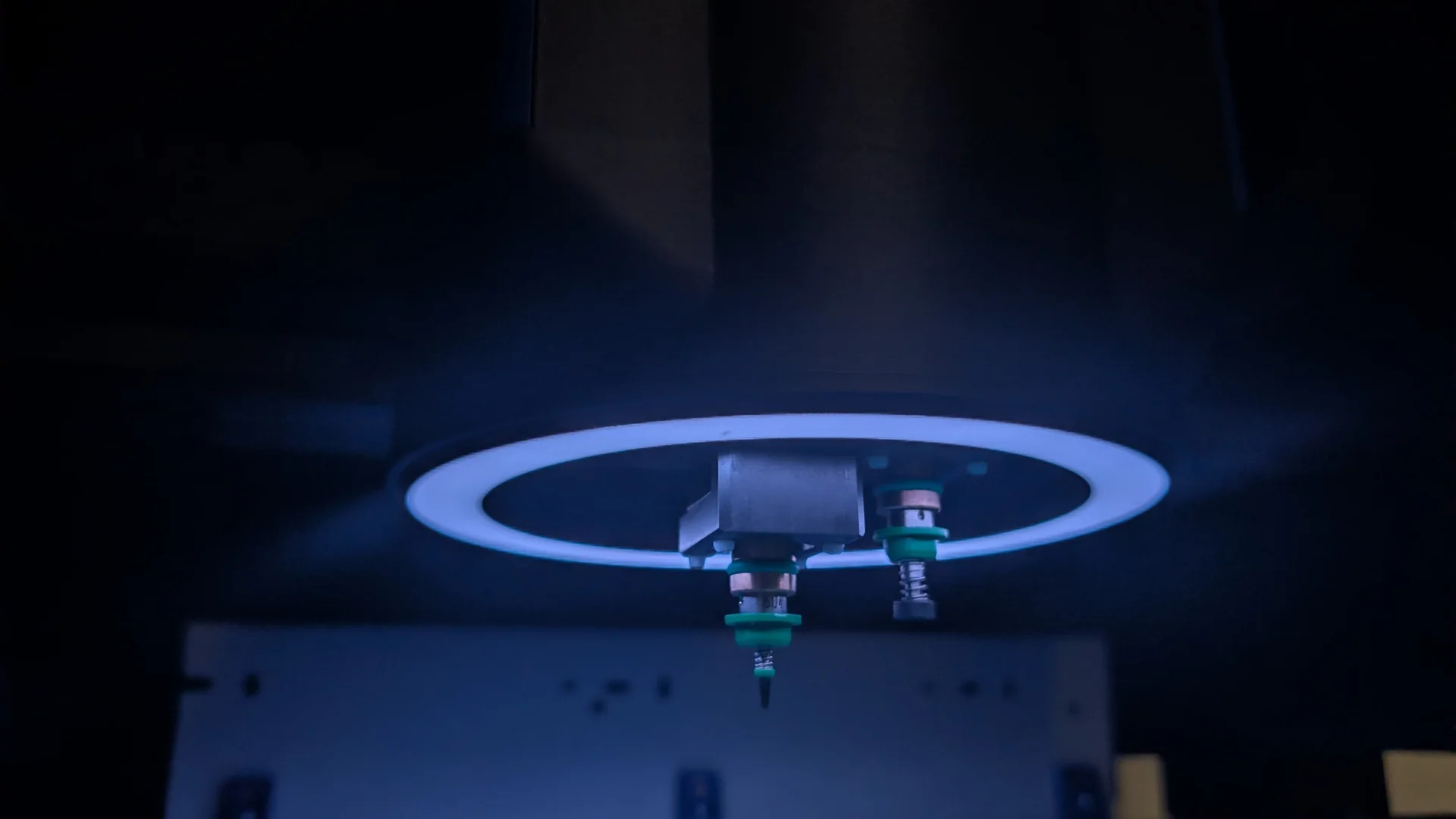
Dual nozzle
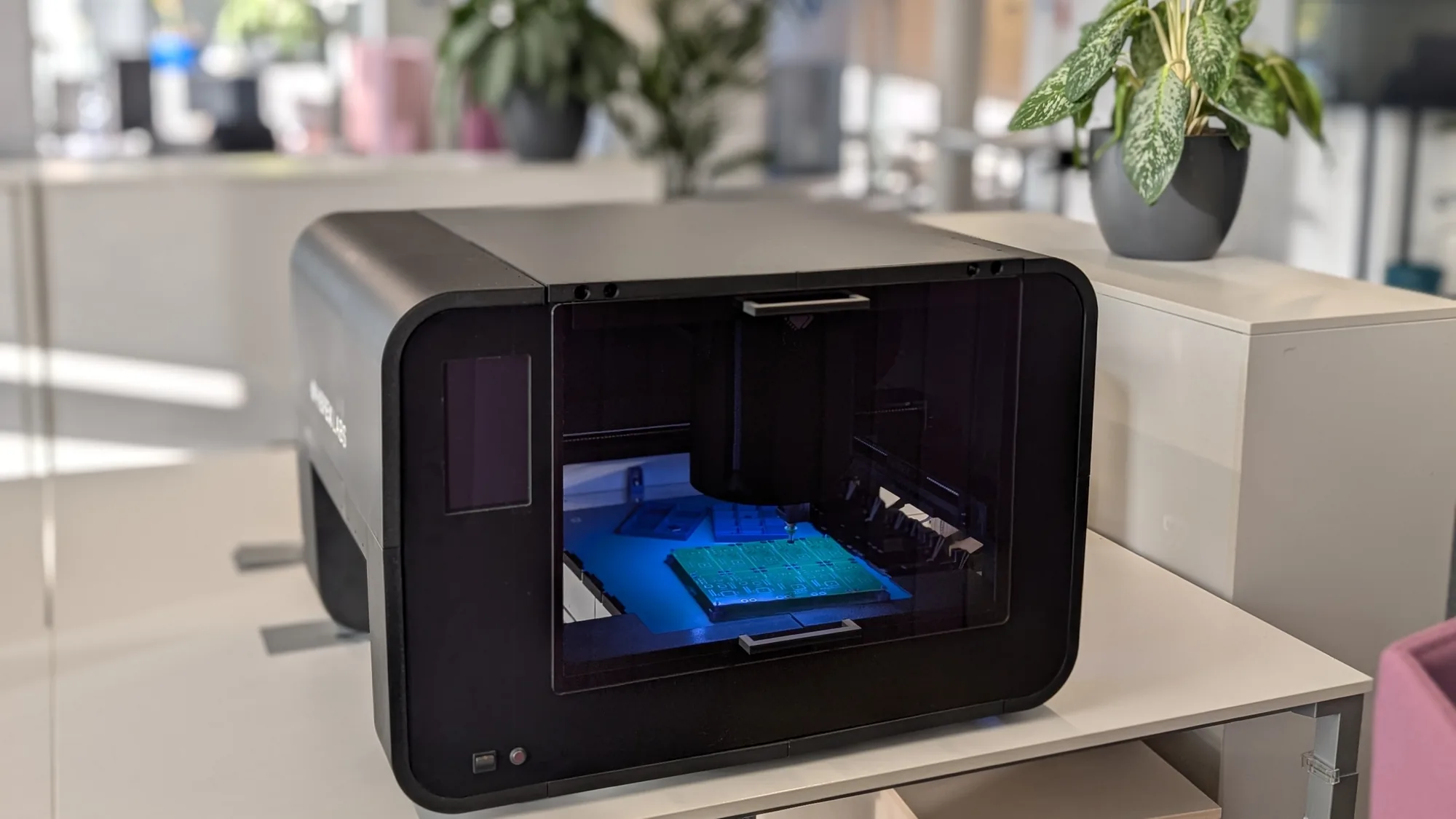
Two nozzles work on the same job. Each picks its part from wherever it is, loose, on tape or in a feeder.
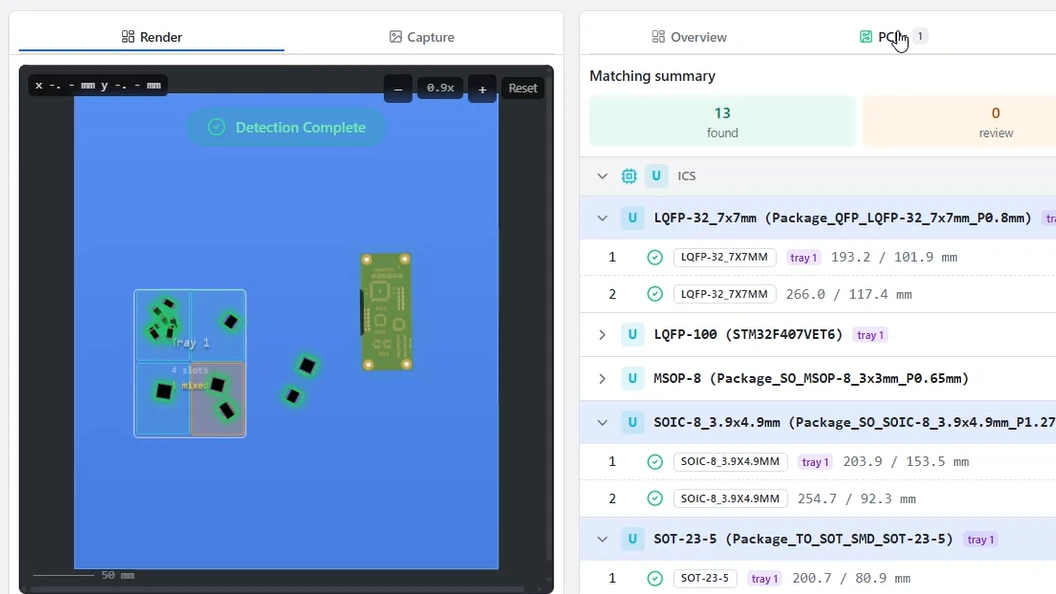
Tray and PCB detection
Any kind of tray is recognized, including its pockets. PCBs and panels are detected as well, without fiducials.
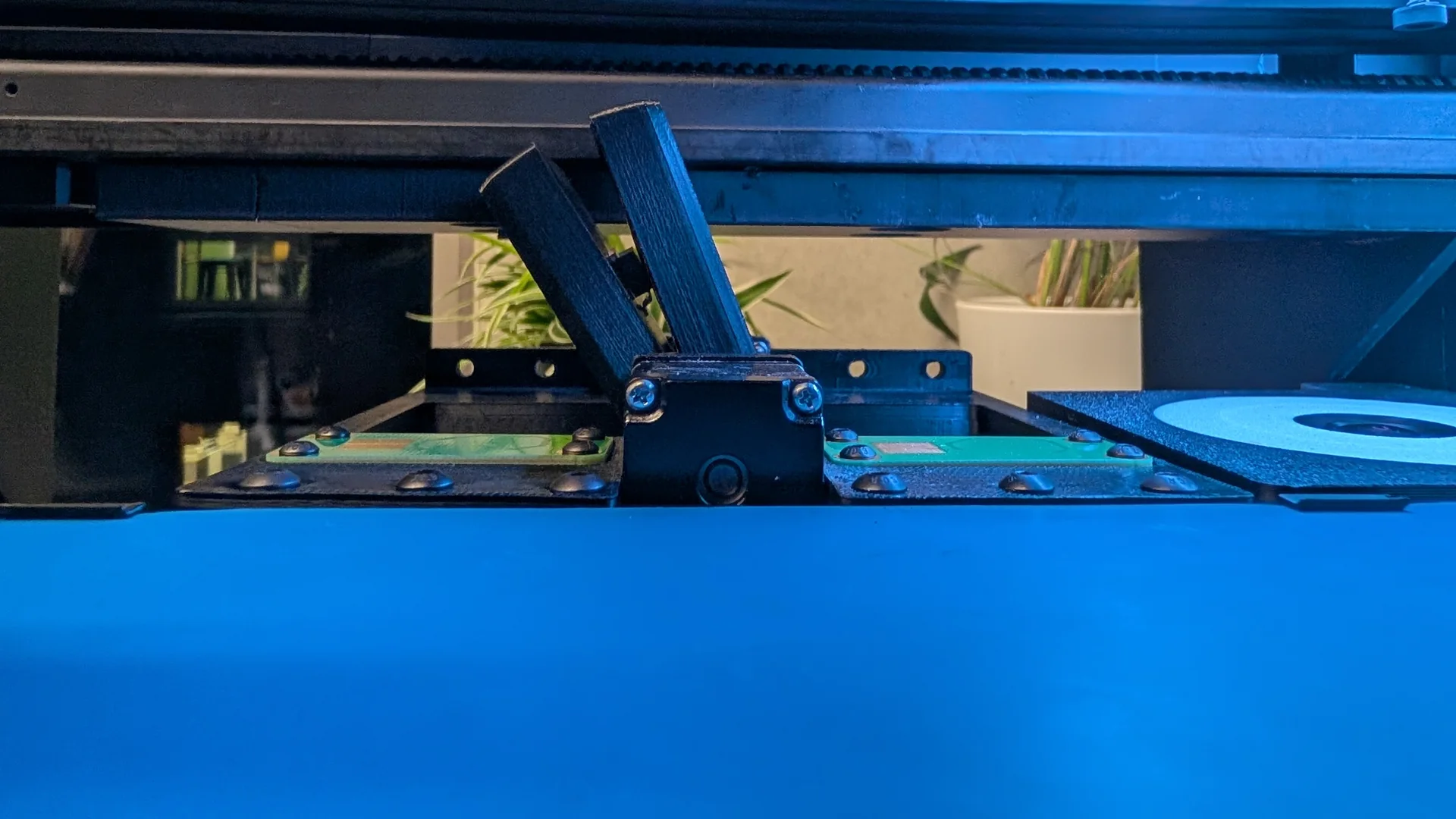
Flipping station
The vision system detects components lying the wrong way up. The machine turns them over on the built-in flipping station and places them.
Data sheet
- Max PCB size
- 300 × 300 mm
- Smallest component
- 0402
- Placement speed
- 500 CPH with vision
- XY repeatability
- ±0.01 mm
- Reel feeders
- 25 (8/12 mm) or 12 (16/24 mm)
- Tape lanes
- 48 (8 mm)
- Flexible working area
- 375 × 330 mm for PCB, trays and tape (excluding feeders)
- Placement heads
- 2
- Max component height
- 50 mm (tape, tray, feeder)
- Minimum pitch
- 0.4 mm
- Minimum BGA pitch
- 0.5 mm
- Max part weight
- 25 g
- Power supply
- 230 V / 500 W
- Connectivity
- 4 × USB, Ethernet, Wi-Fi, HDMI
- Internet connection
- Required
- Machine dimensions
- 850 × 695 × 570 mm (W × D × H)
- Machine weight
- 40 kg
The Hefex Etna needs an internet connection: component recognition runs in the cloud. Design files, images and job data are processed on servers in Germany.
- 01Electrical differentiation of identical-looking components
- 02Automatic flipping of components
- 03Nozzle changer (8 slots)
- 04Support for 0201 components
Planned features. They arrive as software updates on the hardware every Hefex Etna ships with, so there is nothing to retrofit. They are not part of the pre-order scope and not guaranteed. What we commit to is the data sheet.
Components
A taught feeder for every part type, trays only with heavy programming
Reels, cut tape, any trays or completely loose, mixed, without any additional setup effort
The PCB
Clamped, located and calibrated first
Flexible, with or without a fixture, no fiducials required
A new component type
Manual training and configuration
Recognized out of the box
Design data
Converted by hand into the format the machine requires
Upload the assembly file, the software prepares it automatically
Placement program
Written and maintained manually, job by job
Generated automatically from the design data
Operator
6 to 8 hours of training and experience required
Guided by the software, no experience needed
First setup
About a day, usually with a technician on site
Unbox, plug in, start, run a few automatic calibrations, much like a modern 3D printer
From file upload to assembled PCB
90+ minutes
≤ 10 minutes
From file upload to assembled PCB.
* depending on the number of boards and components
80+ minutes saved on every job, from file upload to assembled PCB.
5 reasons teams choose the Hefex Etna
- 01No expertise requiredAnyone can operate it, with no pick-and-place experience at all. The software guides you through every step, and at the end you have an assembled board.
- 02Ready to use immediatelyNo lengthy setup or onboarding process: power it on and get started right away.
- 03No training phase for new componentsUnlike many existing systems, it doesn't need to be manually trained or configured for each new component type. It recognizes and places all components out of the box.
- 04Flexible component feedingLoad reels, tape sections, loose parts, or trays in any mix, exactly as you have them on hand. No pre-sorting or repackaging needed.
- 0590% faster to the assembled PCBThe result of the four points above: from file upload to assembled PCB in 10 minutes or less instead of 90+, and the engineering time goes into the actual work.
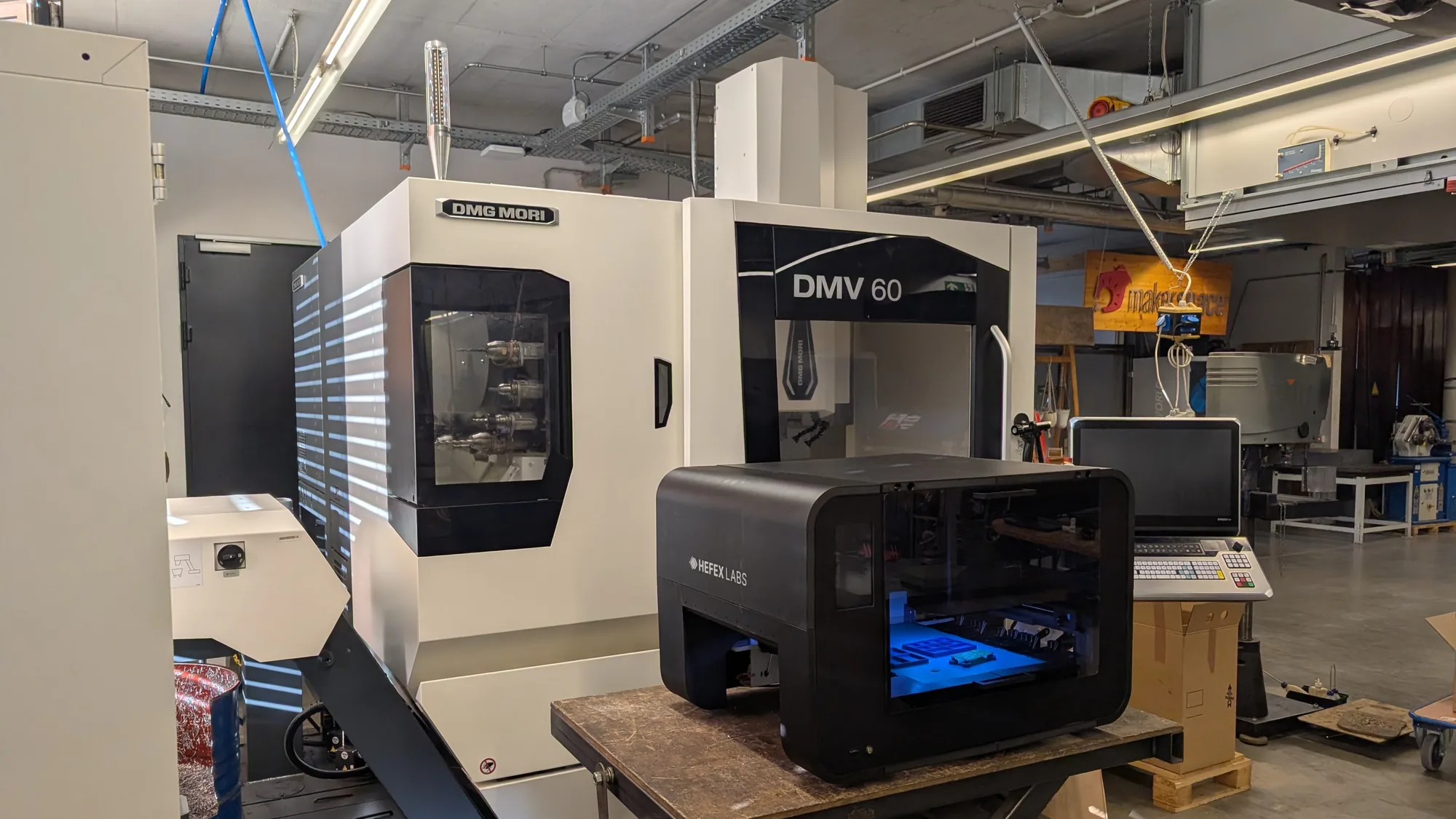
Yes: one limited founding batch, one chance to be among the first.
Founding batch, limited
Founding batch deliveries
Planned for the end of H1 2027
Later batches
Ship at least 6 months after the founding batch, and the founding price is not guaranteed for them.