

Why Isn't Everyone Building Their Own Boards Yet?
Cheap parts and better design tools were never the barrier. The barrier is the friction between a finished design and a board in your hand, and it is starting to give.

Author
Daniel Spitze
CEO, Hefex Labs
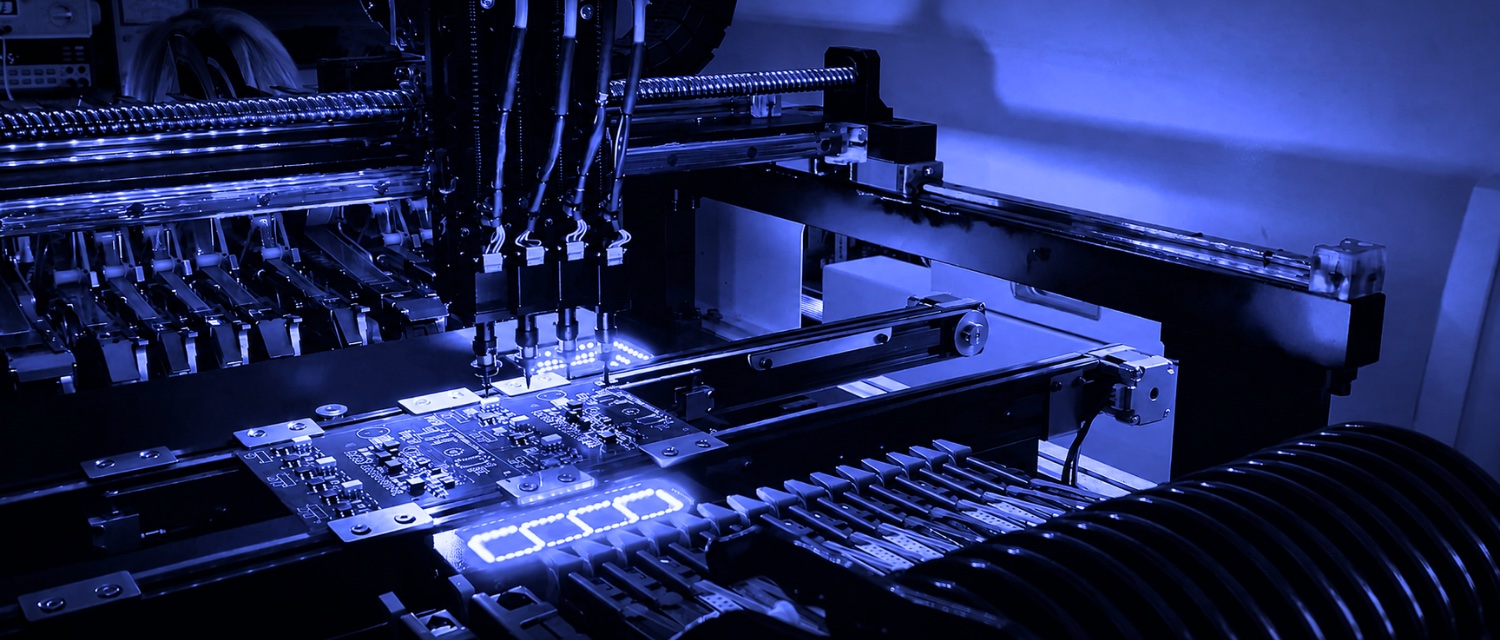
Part of Hefex Notes — field observations on electronics development, prototyping, and the AI and startups reshaping them. This is the second piece; the first was The Assembly Cliff.
Every few years a technology crosses the line from something specialists do to something anyone can do. Desktop 3D printing crossed it. And when it did, the reason was not the one most people remember. Cheap printers had been around for years before the flood came. The machines were never the thing holding it back. What changed was that the friction finally disappeared: the setup, the calibration, the tuning, all the quiet work between wanting a print and getting one. The barrier was never the price. It was the friction. Electronics is approaching the same line now, for the same reason, and this time AI is what dissolves the friction.
We know how a flood like this behaves because it already happened once, in an industry one step over, and almost everyone remembers the reason wrong.
The nine-year gap
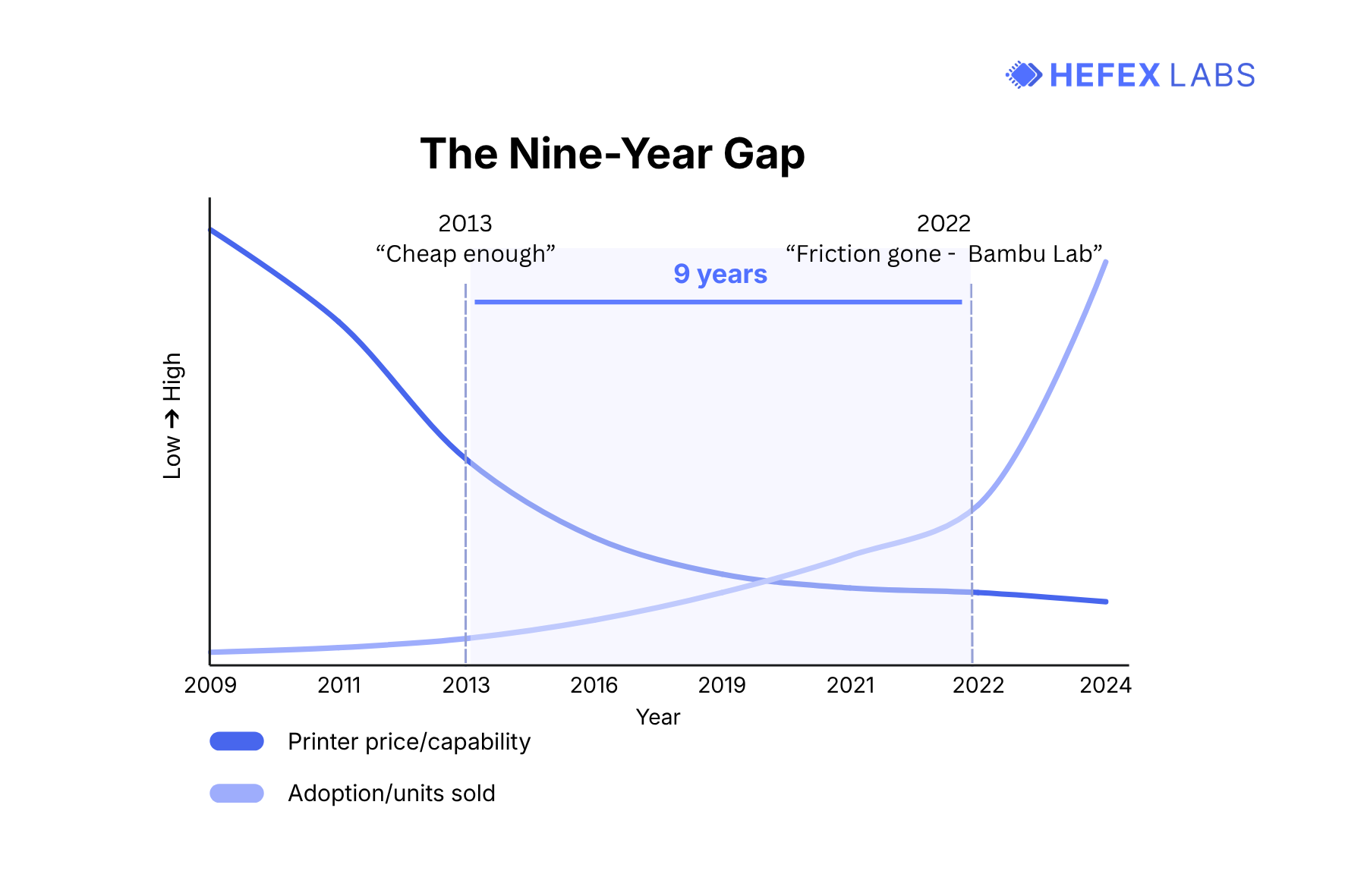
In 2009, desktop 3D printing launched with the confidence of a revolution. The press promised a printer in every home, as ordinary as the inkjet beside it. Chris Anderson called it the next industrial revolution [9]. It didn't arrive. By the mid-2010s, most of the consumer 3D printing companies were gone [1], and the brand that started the wave retreated into selling into classrooms and let its own name go cold [2].
The standard explanation is that the technology wasn't ready. That explanation is wrong, and being wrong about it is expensive, because it hides the thing that actually controls when a technology floods. The price was already there: capable machines sold for three to five hundred dollars by the mid-2010s [3]. The flood still didn't come. It came in 2022, the better part of a decade later, when Bambu Lab shipped a printer that simply worked, straight out of the box [4]. One of its own executives named the mechanism in a sentence: the technology had existed for decades, but someone had to make it simple, stable, and trustworthy [5]. Nine years separated cheap enough from flood. The price was never the dam. It was the friction.
"Nine years separated cheap enough from flood. The price was never the dam. It was the friction."
The pattern underneath
So the useful question about electronics isn't whether the parts are cheap or the design tools are improving. They are. The useful question is where the friction actually sits, and what is finally dissolving it.
Why electronics held longer
Electronics is a harder case than 3D printing, and it's worth saying why. A printer works with one material and one machine. A board needs parts pulled from a global supply chain, and once they arrive, something still has to place them, solder them, and check the result. There is more between the idea and the object, and more that can stop it.
That difference is usually read as a reason the flood won't happen here. It's the opposite. The barrier held longer because it was harder, and a barrier that holds longer has more behind it when it gives. The flood is later than it was for 3D printing. It will also be larger.
Two dams, not one
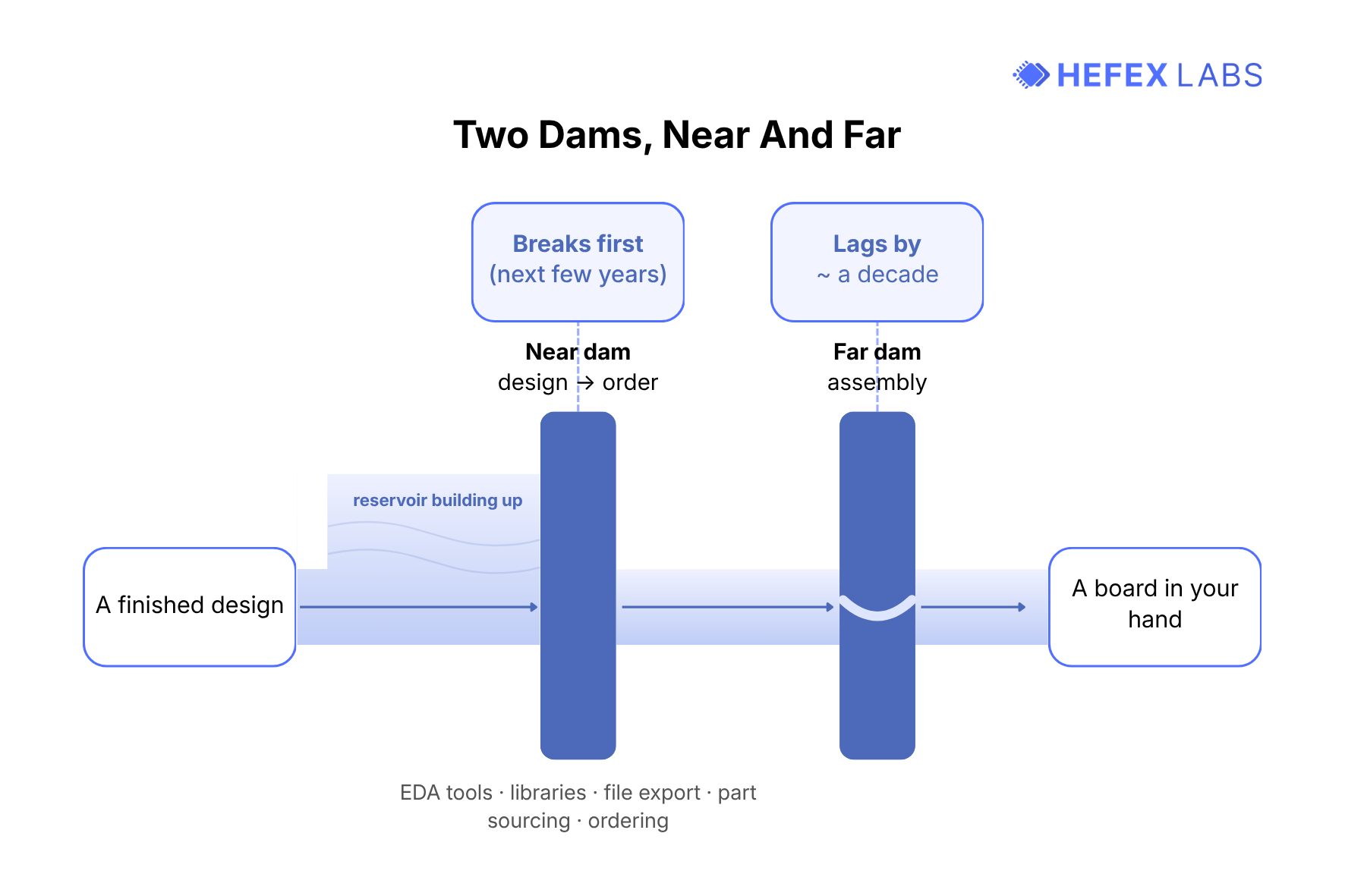
The electronics barrier is really two, stacked, and they get lumped together as one.
The near dam isn't a single wall. It's a staircase of small steps, and that is exactly why it holds. Choosing an EDA tool. Getting the library and the footprints right. Exporting the files the fab expects. Matching every part against what a distributor actually has in stock. Placing the order in a form the factory will accept. No single step is hard. Any one of them, alone, is a solvable afternoon. But they stand in a row, and each one sheds a few more people than the last. What stops someone is never a wall. It's the tenth small step after nine others.
"Footprints, DRC rules, ordering felt like a second, unrelated skill learned from scratch."
— A. N., on designing his first board
You can watch this happen in public. On vendor forums, first-time orders come back cancelled with no usable explanation. One builder cycled through repeated rejections before discovering, by guessing, that a single-layer board needed an empty drill file the tool never asked for [17]. To the practitioner none of this registers. For someone already over the wall, it is minutes and a few dollars from breadboard to a professional board [18]. That is the trap. The practitioner doesn't know the wall is there because he stopped feeling it years ago. The people who build the tools and set the formats are all long since over it, so they build for someone who already is. It is the same silent assumption Note 1 found one step downstream, that an expert is standing at the interface. That is what a dam looks like: invisible from above, total from below.
The far dam is assembly itself. We've written about it at length in Note 1, so we won't relitigate it here. The short version: even once the order is placed, physically populating a board at prototype and low volume stays the slowest, least automated step in the loop, and it stays that way for structural reasons, not technical ones. The cliff does not move just because a file made it out the door.
These look like two topics. They are one barrier with two layers — a near one and a far one.
Why now, and in what order
Both layers are finally under pressure. But they will not give way together, and the order matters more than the fact.
Why now
What changed is AI, and on this staircase it works from two directions at once.
The first is the obvious one: the tool. The tedious parts of board design are starting to fall to software. AI assistants already read and write Altium and KiCad projects through open MCP servers, generating IPC-compliant footprints for a new component straight from a datasheet, work that used to cost engineers weeks of library maintenance [6]. On the KiCad side, plugins like Konnect expose well over a hundred tools to a model like Claude, from footprint placement to routing to the manufacturing export itself [7]. It's early and openly in beta, which is the point: the pieces exist, they just aren't dependable yet. Producing a design is getting cheaper and faster. The same thing is starting one step down, on the path from a design to an order. The libraries are getting better with every release [16], and a growing ecosystem of open-source add-ons fills in the rest, so footprints and part data that used to be manual increasingly come correct by default and a whole class of translation errors stops being created at all. The parsers are getting better too: a new class of tools ingests messy BOMs and PCB files and normalizes them automatically, turning hours of cleanup into a background step.
A live example sits right at this seam. Luminovo, a Munich-born company building software for the electronics supply chain, automates exactly this preparation for the manufacturers who take in customer orders. The numbers they report are not incremental.
"90% faster cycle time, 50% less manual work."
— Sebastian Schaal, CEO, Luminovo
The second role shows up in no single tool. AI is why the people are here at all. A corner of hardware that sat unattended for years is suddenly crowded: the EDA-software field now counts more than 260 companies, and this year's Design Automation Conference fielded on the order of 130 AI-EDA vendors [11]. Most will not deliver what their launch copy promises. That isn't the point. The density is. A barrier made of small steps falls when enough people decide it's worth their time, and for the first time that many are pushing on the same staircase at once.
The tools are not there yet, and it matters.
"Autorouters were too sophisticated to abandon but too limited to trust."
— DeepPCB, on sixty years of routing automation [10]
Automation in engineering tends to overpromise, then deliver, later and in a different shape than the launch suggested. The tools that break the near dam won't be the ones with the best demo. They'll be the ones that quietly become reliable. The flood doesn't start when the tools ship. It starts when they work.
Put the two dams on a clock and they come apart. The near one, the staircase from design to order, gives first, over the next few years. The far one, assembly, lags it by closer to a decade, reshaping slowly. For a while you'll be able to summon a manufacturable board faster than anyone can physically build it. That is Note 1's thesis, one level up.
None of this is mature. MCP servers and design agents are months old, not years. What's visible today isn't the shape of the change. It's the first minute of it.
What breaks loose
When the near dam goes, watch three things.
The first is that the development board stops being the ceiling. Millions of people, hobbyists and startups especially, build on off-the-shelf boards: an Arduino, an ESP32, one of a thousand variants. For many of them that board is as far into hardware as they go, not because they need it to be, but because rolling their own was never worth the climb. They reach for the shelf because it's convenient. Soon they won't have to. The same board becomes a starting point instead of a limit: keep the parts you use, drop the ones you don't, add the feature you actually need, change the shape to fit. The software side is already handled; the language models took care of that. What kept people on the shelf was never the soldering. It was everything between a design and an order, and that is the staircase now coming down.
The second is a change in the shape of who builds. This won't look like 3D printing, where the machine landed on a hobbyist's desk. Some R&D labs will pull a machine in-house, but the larger change is one level up, at the contract manufacturer.
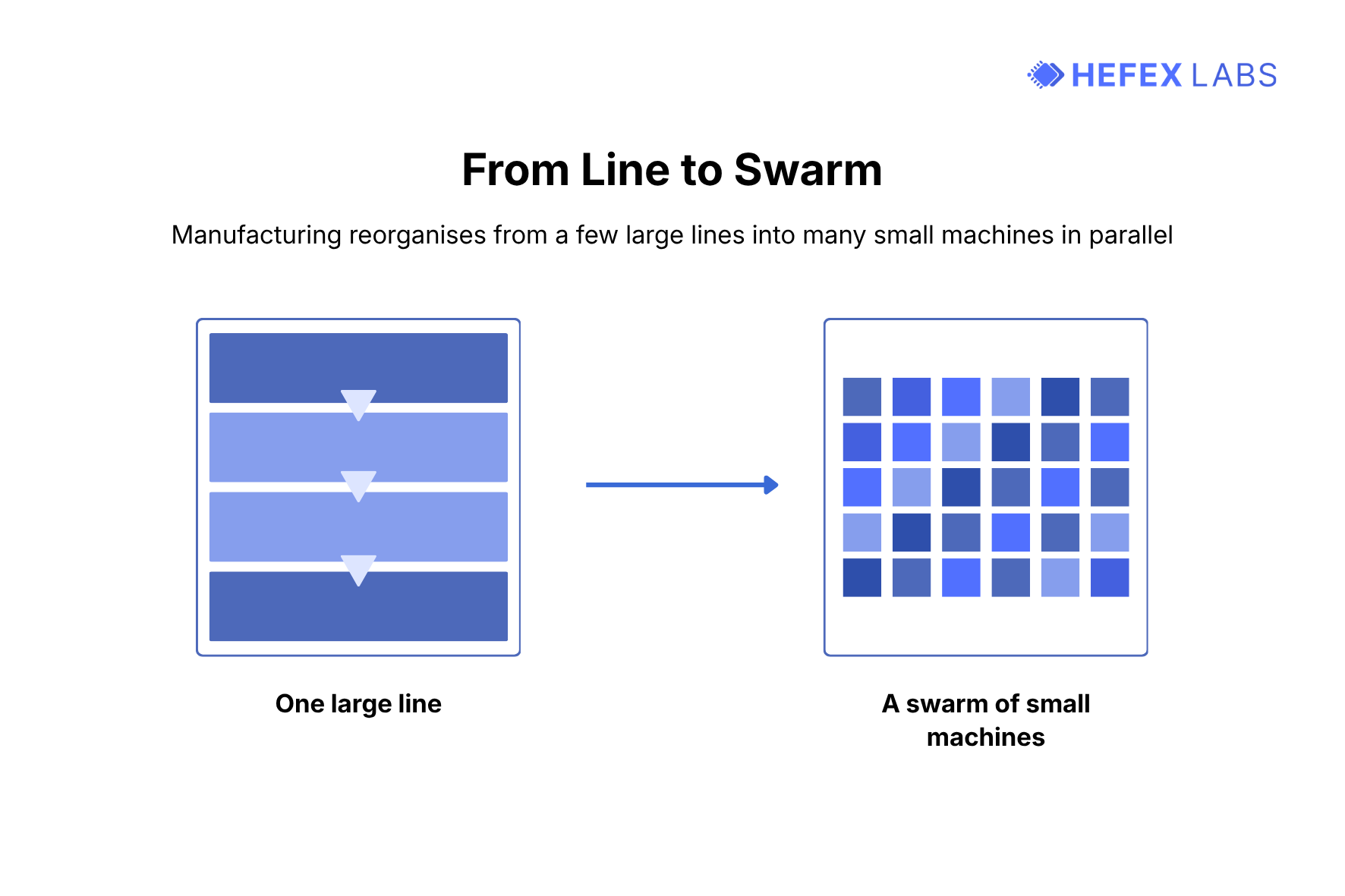
Low-volume, high-mix is already the acknowledged trend, and the large assemblers say they're addressing it. What they don't say is how. Their answer to high-mix is still their expensive line, sold a little differently, because their business runs on selling large, costly machines. The honest answer points the other way. It isn't a better industrial line, it's the opposite: a small machine, closer to a 3D printer, built on deliberately modest hardware and carried by AI and software, with fifty of them in a room instead of one line. Not precision bought with expensive mechanics, but scale bought with numbers and intelligence. That is the print farm, moved up the stack from plastic to boards. From line to swarm.
None of this replaces the production line. Serial runs still want one, and plenty of prototypes exist only to be optimized into a serial product later. The swarm is the answer for the work that never reaches those volumes, and for the long climb before it does, which is where iteration actually happens. It's also the answer to the standing objection that hardware can't scale the way software does. It scales, just not as a machine on your desk. It scales as a swarm behind an order button.
The third is a whole class of things that don't get built today. Not cheaper versions of what exists, but products that never existed, because the numbers never worked: the one-off, the repair of a board no manufacturer supports anymore, the narrow product that dies on minimum order quantity before it's ever made. When a run of one to fifty stops being uneconomical, the constraint that quietly killed those ideas is gone. This is the shift additive manufacturing already went through, where the value moved to the high-mix, low-volume work older tooling couldn't reach [8]. The most interesting boards of the next decade are the ones nobody builds right now, because at a thousand units they make no sense, and at a handful, on demand, they suddenly do. Low volume isn't a phase on the way to scale. It's the destination.
The reservoir is already filling
You don't have to take this on faith. The pressure behind the near dam is already measurable.
On the fabrication side, the step that already became a button, the flood is visible. JLCPCB, a single prototype-scale fab, reports more than four million customers and over twenty thousand orders a day [12], and its online business is growing double digits year over year [13]. That isn't mass production. It's a torrent of small, mixed, one-off boards, exactly the demand a frictionless order step unlocks. Fabrication became a button, and the boards came.
On the assembly side, the step that hasn't, the demand shows even though little exists to meet it. An open-source desktop pick-and-place, the LumenPnP, grew from a YouTube project into a machine thousands of people build themselves, because they want in-house assembly badly enough to assemble the robot first [14]. As Note 1 argued, machines like these lower the price of the hardware, not the difficulty of running it. But as a demand signal, people building their own pick-and-place is about as loud as it gets.
The near dam shows its outline in the tooling that grew up to survive it. Because a design tool and a fab can hold different versions of "the same" rotation standard, a small industry of plugins exists for one purpose: fixing component rotations and offsets before a board can be ordered, with communities maintaining shared per-footprint correction tables [15]. That is what a dam looks like from below. Not a wall, but the scaffolding people build to climb it.
The reservoir is full on both sides of the near dam. What's left is the dam.
The analogy has limits, and they cut in our favor, not against. Electronics isn't 3D printing: a board depends on a global supply chain, and it has to actually work, not merely come out looking right. Those are real constraints, and they're exactly why this took longer to arrive, and why the naive version of the prediction, a circuit-board printer on every desk, is wrong. They don't hold the flood back. They're the reason it builds behind a higher wall, and the reason it arrives as something bigger and stranger than a consumer gadget: a restructured supply chain, not a toy. The one thing none of these limits touch is the direction. That's already set.
What it means
The point isn't a particular tool or a date. It's that the thing deciding when hardware opens up was never the price of parts or the cleverness of the design layer. It was the staircase of small steps between a design and a board in your hand, each one trivial, all of them together a wall. That wall is coming down, step by step, and AI is taking it down twice over: as the tool that lowers each step, and as the reason enough people are finally standing at the wall to push.
What comes through isn't a printer on every desk. It's stranger than that: a generation that stops buying the board and starts drawing its own, and a manufacturing base that reorganizes from a few large lines into many small ones. None of it is finished. MCP servers, design agents, the first honest attempts at one-click ordering, all of it is weeks and months old. This is not the shape of the change. It's the first minute of it.
Who captures the value when a hundred companies rush the same opening is a separate question, and the answer isn't the hundred-and-first wrapper around a foundation model. That's a note for another day.
Hefex Notes is where we write up what we see in electronics development and manufacturing, and how AI and a new wave of startups are reshaping them. Field observations, not product pitches. More to come.
Curious about the future of electronics R&D?
Receive our latest updates on electronics prototyping, AI-powered hardware tooling, and product milestones.
By subscribing you agree to our Privacy Policy. You can unsubscribe at any time.
References
- [1]thediligence, "What happened to the 3D Printing Revolution?" — consumer-company shakeout (>90% failure). https://thediligence.com
- [2]TechCrunch, MakerBot retreat to education / factory closure, 2016. https://techcrunch.com
- [3]Southern Fried Science / Maker Hacks — sub-$500 capable printers by mid-2010s. https://southernfriedscience.com
- [4]3D Printing Industry — Bambu X1 launch, self-calibrating/enclosed/one-button. https://3dprintingindustry.com
- [5]BigGo Finance, 2026 — Bambu revenue >$1.5B, 1M units in China, exec quote on simplicity. https://finance.biggo.com
- [6]embedded-society/altium-designer-mcp, mcpmarket.com/server/altium-designer, KiCad-MCP — AI assistants reading/writing EDA projects via open MCP servers. https://github.com/embedded-society/altium-designer-mcp
- [7]Konnect — native KiCad 10 plugin exposing ~185 tools to LLMs (schematic, layout, routing, ERC/DRC, part search, manufacturing export), beta — github.com/mixelpixx/Konnect. https://github.com/mixelpixx/Konnect
- [8]Grand View Research / 3D Printing Industry — additive manufacturing value in high-mix/low-volume. https://grandviewresearch.com
- [9]Chris Anderson, "Makers: The New Industrial Revolution," 2012 — 3D printing as "the next industrial revolution." https://www.penguinrandomhouse.com/books/212945/makers-by-chris-anderson/
- [10]DeepPCB, "The 60-Year Routing Problem Nobody Solved," 2026. https://deeppcb.ai/the-60-year-routing-problem-nobody-solved/
- [11]Tracxn, 2026 (~260 EDA companies); EE Times, "AI in EDA Is Real…", DAC 2026 (~130 AI-EDA vendors). https://tracxn.com
- [12]JLCPCB — >4.1M customers, >20,000 orders/day (jlcpcb.com). https://jlcpcb.com
- [13]Grips Intelligence — JLCPCB online revenue ~$273M 2025, +20–50% YoY. https://grips.ai
- [14]github.com/opulo-inc/lumenpnp; Wikipedia "LumenPnP" — open-source desktop PnP, ~3.5k GitHub stars. https://github.com/opulo-inc/lumenpnp
- [15]bennymeg/JLC-Plugin-for-KiCad, KiBot; community rotation tables — rotation/offset correction plugins. https://github.com/bennymeg/JLC-Plugin-for-KiCad
- [16]KiCad 10 release and per-release library growth — kicad.org, 2026. https://kicad.org
- [17]DigiKey TechForum, "First try with DK Red, Order cancelled?" — first-time order cancelled, missing empty drill file. https://forum.digikey.com
- [18]Jeff Kaufman, "Circuit Board Ordering" — breadboard to a professional board in minutes for a few dollars. https://jefftkaufman.substack.com