

The Assembly Cliff
Why hardware stalls at the one step no one automated.

Author
Daniel Spitze
CEO, Hefex Labs
Hardware iteration speed is not gated by design tools or by fabrication capacity. It is gated by the step in between: getting components onto the board for prototypes and low volumes. That step is the slowest, least automated, most expertise-dependent part of the entire loop, and it stays that way not because the technology is missing, but because the economics of existing automation collapse at the quantities that prototyping actually runs at. The machines exist. They sit idle for exactly the work that needs them most.
This series is on electronics development, prototyping, manufacturing, and the startups and AI now moving into all three. This piece is about the part everyone routes around and nobody names.
The loop, as engineers actually live it
The hardware development loop has a fixed shape: design the board, fabricate it, populate it with components, bring it up, find what's wrong, respin. The time it takes to go around once sets the pace of the project, because each turn is one chance to find out whether the last round of decisions was right. Faster turns mean more revisions in the same calendar time, which usually counts for more than the size of the budget behind any one of them.
Two of those four steps are not where the loop gets stuck, for almost opposite reasons.
Design has mature tooling, but the work itself is still largely manual, which is why a wave of startups and AI is now moving in to automate it. It is the busiest part of the loop right now, and still not where projects stall.
Fabrication has been commoditized into a utility. A bare board is now a 24-hour to 7-day transaction at a price that rounds to nothing for a prototype. Upload Gerbers, get boards. The fab houses compete on turn time measured in hours.
The third step is still broken.
The cliff
Once you have bare boards and a reel, or more likely a bag of cut tape, a few trays, and some loose parts, something has to place 60, 120, 200 components onto each board with the right part in the right spot at the right rotation, and then reflow it without cooking it. And this is where the smooth, commoditized, hours-not-weeks experience of the first two steps simply ends.
![Figure 1. One turn of the hardware loop. [1]](/images/blog/assembly-cliff/Notes_Fig1_updated.png)
Yet the machine for this already exists. Pick-and-place is mature technology, in nearly every contract manufacturer and a fair number of well-equipped labs, and it places parts faster and more accurately than any human, better than ±0.05 mm on quality equipment [2]. By that measure the prototyping bottleneck should already be solved by hardware that has been on the market for decades.
It isn't.
Why the machine doesn't get used
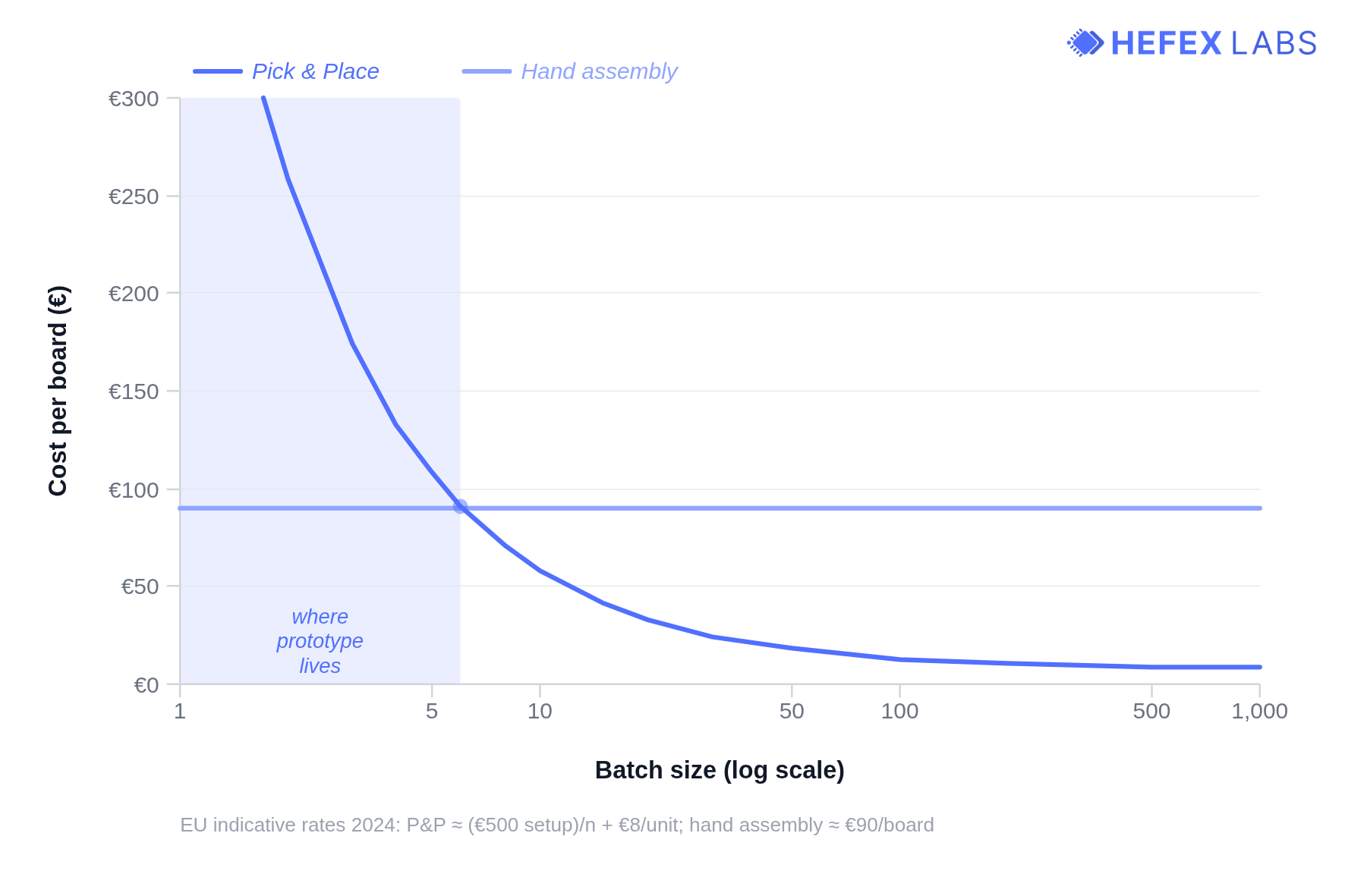
Pick-and-place is engineered for the exact inverse of prototyping. It is built for high volume and low mix, the same board run thousands of times. Prototyping is the opposite: high mix, low volume, often a single board or five, with a hundred-plus unique parts and a different design next week. Every assumption baked into the machine points the wrong way for this work.
The capable machines don't fit. A production-grade pick-and-place is large, expensive capital equipment: the machine, the feeders, the floor space, the infrastructure around it, and someone who can run it. Running it is its own discipline, turning a BOM and placement file into a correct program (centroids, rotation conventions, package-to-nozzle mapping, fiducials, feeder assignments), where a mistake wastes a board and an afternoon. None of that amortizes at prototype volumes: the line is built to be set up once and run for a shift, so for a batch of three boards the setup is the whole job, and reaching for the machine rarely makes sense. The capability is real. The payoff isn't.
The affordable machines aren't turnkey. There is a cheaper tier, desktop and open-source pick-and-place, that dodges the cost and the footprint. These machines do work, but not out of the box: you have to know them well, tune them, and work through a long tail of teething problems before placements are dependable, more so once fine-pitch and dense packages are in play. They lower the barrier to owning a pick-and-place, not the barrier to operating one reliably.
Either way, prototyping loses: the machine that works is out of reach, and the one within reach takes real expertise to get working. That is the gap. Not capability, but cost, fit, and the effort it takes at the quantities real iteration runs at.
This isn't only our read. The equipment industry's own market research says as much: it classifies manual placement as the default for prototyping and low-volume runs precisely because an automated line's capital cost can't be justified there, and it names high-mix programming complexity and the need for skilled operators as what holds the machines back [3]. The people who build pick-and-place equipment have, in effect, already conceded the gap — they just call it a market they don't serve rather than a problem to solve.
The four ways people route around it
The same gap shows up in what people actually do. Every workaround is evidence that it's real, and the people working around it are not a narrow group: solo hardware founders, R&D labs inside large companies, contract manufacturers themselves, and university and research groups — anyone whose work is measured in boards by the ten, not the thousand. Talk to enough of them and the same four patterns come up again and again.
They own the machine and place by hand anyway. Shops with a pick-and-place line on the floor still populate prototype boards by hand. The most automated option available is sitting right there, already paid for, and for a one-off the tweezers and microscope still win.
"I have a pick-and-place machine, yet my team still hand-assembles most prototypes because the setup takes too long."
— CEO of a PCB assembly firm, Munich area
They have the need and don't buy the machine. Some teams prototype often enough that a machine should obviously pay for itself, and they still don't buy one. The demand is real, the purchase doesn't happen, because owning the machine means taking on everything in the section above, and that overhead swamps the benefit.
"We considered buying a pick-and-place machine, but didn't. Not because of price, but because existing machines are too complex to set up."
— CTO at an automotive supplier, Stuttgart area
They outsource and wait. Sending boards out for assembly trades the setup problem for a lead-time problem. Now your iteration loop is paced by someone else's queue, their component sourcing, and shipping. That is weeks, not hours, and every respin pays the toll again. The board you could fabricate overnight takes a multi-week round trip to populate.
"We order from JLCPCB in China and wait three to six weeks, every time."
— Electronics lead at a startup, Munich area
They can't hand-place at all. There is also a ceiling. Many modern packages cannot be reliably hand-soldered: fine-pitch, leadless, BGA. Once your design crosses that line, the manual fallback that the previous three routes leaned on simply isn't available. You're forced onto a machine or a service, with no hand-assembly escape hatch, which means the friction above isn't an inconvenience anymore. It's a wall.
None of these four is a solution. They are compromises, accepted because every alternative is worse. The common thread is simple: hand-assembly doesn't scale and the machine doesn't fit, so the work falls into the gap between them. That gap is not a niche. It is the everyday condition of prototyping and low-volume production.
Why the gap persists
If this gap is so visible, why hasn't it closed on its own? Because it sits in a structural blind spot that neither side of the existing market has an incentive to fill.
On one side, the high-volume automation vendors optimize relentlessly for throughput, because that's what their customers — mass producers — buy. Every engineering dollar goes into placing more parts per hour, which does nothing for a problem whose binding constraint is changeover and first-time-right, not speed. Throughput is the wrong objective function for this work, so throughput-optimized tools structurally ignore it.
On the other side, the low-cost and open ecosystems — OpenPnP and the world of converted desktop machines — attack the price of the machine, because that is the barrier their community feels most. That is real progress, but it is a different target. Driving hardware cost toward zero does nothing about changeover and first-time-right, so even the cheap end of the market optimizes around the constraint rather than at it.
And there is a deeper reason no one has reached across that divide: the work doesn't fit the way today's players are built. To a high-volume vendor it is low-margin and high-touch; to the hobbyist tier it is too small to move the needle. It falls outside both business models, not because there is nothing there, but because serving it well would take a different one. So it has stayed open while the rest of the loop got solved around it.
The neglect runs the length of the line, not just the placement step. Take something as basic as a small reflow oven with a documented serial or network interface — the kind of building block any automated low-volume workflow would reach for first. It barely exists. The surrounding process equipment is built on the same unspoken assumption as the machines: that a human operator is standing in front of it, and that nobody is seriously trying to automate work at this scale. For a field whose entire future is more designs, smaller batches, faster turns, that assumption is remarkably comfortable. It's also exactly the assumption that has to break.
What the design trend overlooks
Earlier we set design aside as the busiest part of the loop and not the place it stalls. That is where most of the current attention goes: better automation, lower barriers to entry, and an emerging wave of AI-assisted and natural-language tools that promise to turn an intent into a schematic and a layout. Some of it is hype and some of it is real, but the direction is clear. Producing a board design is getting easier, and it will keep getting easier.
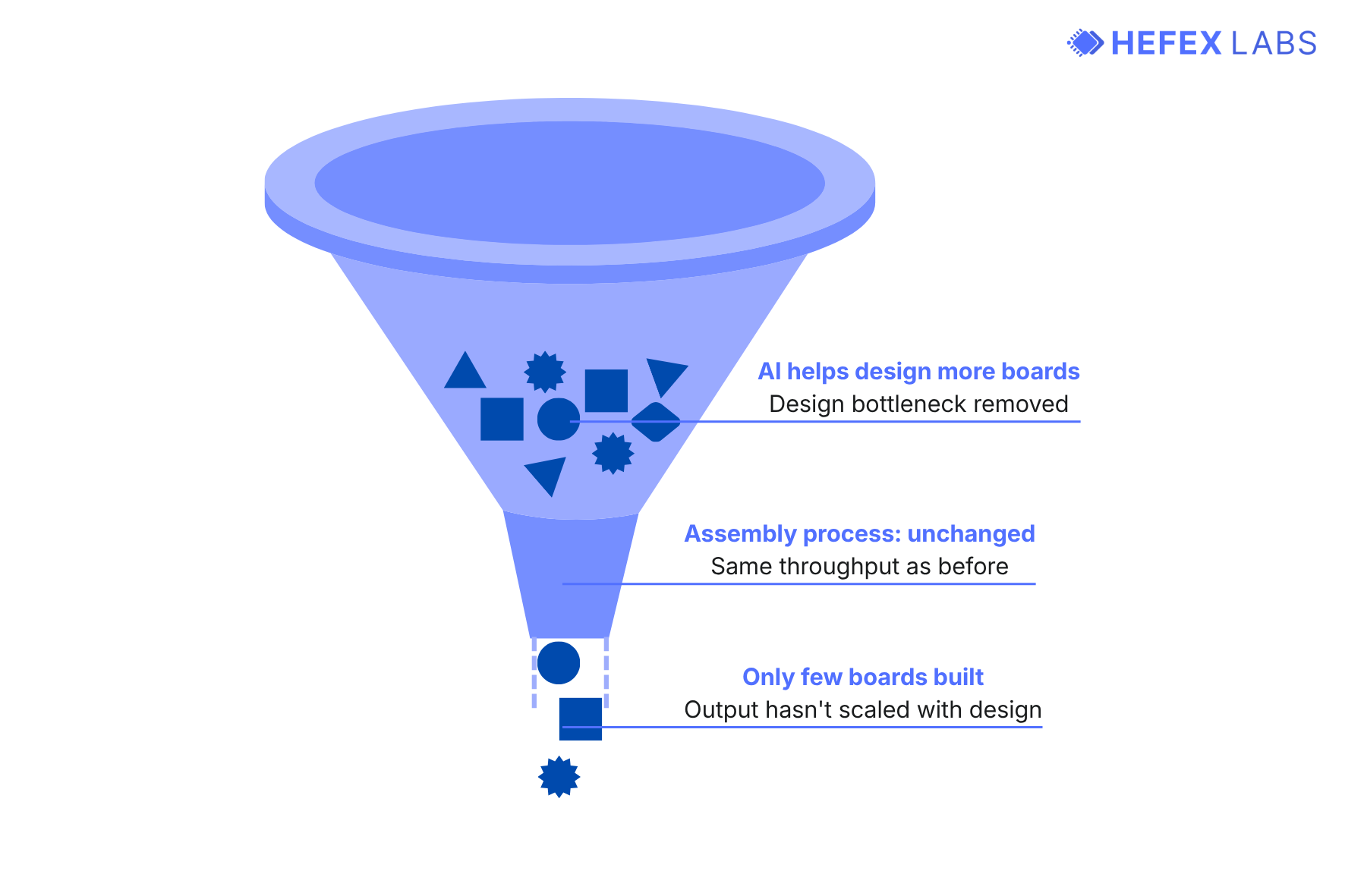
This is celebrated as progress, and in isolation it is. But it speeds up the one step that was never the problem. Faster design just means more designs, produced sooner, all landing on the same assembly step that has not sped up at all. So the more the design tools succeed, the more work piles up at the cliff, and the worse it gets. The funnel is being widened at the top while the neck stays exactly as narrow as it is today.
And this is not only about prototypes on their way to mass production. A large and growing share of electronics is high-mix and low-volume by nature [7]: specialized boards for industrial, medical, aerospace, and niche applications that were never meant to ship in the millions. The same shift is already visible one industry over. Additive manufacturing grew into a market worth tens of billions [4] by serving exactly the work traditional tooling can't reach economically — low-volume, high-mix, frequently changing parts with no production run to amortize a mold against. A peer-reviewed comparison places its economic advantage squarely in high-mix, low-volume production, where tooling costs dominate [5]. Electronics assembly is on the same path, without an equivalent answer yet. For this work, low volume is the destination, not a phase.
The market data, noisy as it is, points the same way. The overall PCB-assembly market grows in the mid-single digits a year [6]. The telling detail isn't that headline number. Among assembly methods, the fastest-growing one is manual soldering, attributed by analysts to prototyping, low-volume production, and repair [6]. In an industry whose entire trajectory points toward automation, the most hands-on method is the one gaining fastest, because that's where the new, small, mixed, fast-changing work keeps landing, and the machines can't economically take it. The bottleneck isn't a thesis you have to accept on argument. It's visible in which segment is growing.
There's a quiet version of this that's easy to miss and a loud version that's coming. The quiet version is now: assembly is already the bottleneck, it's just hidden behind a design step that's still slow enough to look like the holdup. The loud version arrives the moment design stops being the gate. When anyone can generate a working board on demand, the only thing standing between an idea and a physical prototype is the step this entire piece is about. At that point the bottleneck isn't one constraint among several. It's the whole story. The people who don't see it yet will see it then.
What this means
The point is that prototype and low-volume assembly isn't a fixed cost of doing hardware. It's the thing setting how fast you can iterate, and how cheaply you can make anything that isn't a mass-market product. The respin you're waiting three weeks on, the pick-and-place you bought and don't use, the board you redesigned to keep it hand-solderable — those aren't separate annoyances. They're the same constraint, and it's pacing the entire development cycle.
None of this is permanent. Fabrication used to be slow and bespoke too, until it wasn't, and the whole loop reorganized around the step that got fast. Assembly is the step that hasn't gotten there yet. Gaps like this don't close gradually. They hold, and hold, until someone builds for the constraint everyone else has been routing around. Then they close all at once.
Hefex Notes is where we write up what we see in electronics development and manufacturing, and how AI and a new wave of startups are reshaping them. Field observations, not product pitches. More to come.
Curious about the future of electronics R&D?
Receive our latest updates on electronics prototyping, AI-powered hardware tooling, and product milestones.
By subscribing you agree to our Privacy Policy. You can unsubscribe at any time.
References
- [1]PCBSync, "Quick Turn PCB Assembly," 2026. https://pcbsync.com/quick-turn-pcb-assembly/
- [2]Juki Automation Systems, "Placement" (machine specifications), 2025. https://www.juki-smt.com/en/products/placement.php
- [3]Global Market Insights, "Pick and Place Machine Market," 2026. https://www.gminsights.com/industry-analysis/pick-and-place-machines-market
- [4]Grand View Research, "Additive Manufacturing Market," 2026. https://www.grandviewresearch.com/industry-analysis/additive-manufacturing-market
- [5]3D Printing Industry, "Additive Manufacturing Benchmarked Against Injection Molding in Mass Customization Study," 2026. https://3dprintingindustry.com/news/additive-manufacturing-benchmarked-against-injection-molding-in-mass-customization-study-250041/
- [6]Global Market Insights, "Printed Circuit Board Assembly Market," 2026. https://www.gminsights.com/industry-analysis/printed-circuit-board-assembly-market
- [7]Verified Market Research, "SMT Pick and Place Machine Market," 2026. https://www.verifiedmarketresearch.com/product/smt-pick-and-place-machine-market/